The making of Cobalt Core: how Tabletop Simulator and Inscryption were the secret catalysts behind this clever deckbuilding roguelike
Rocket Rat Games walk us through creating a replayable and reactive card game with just two people
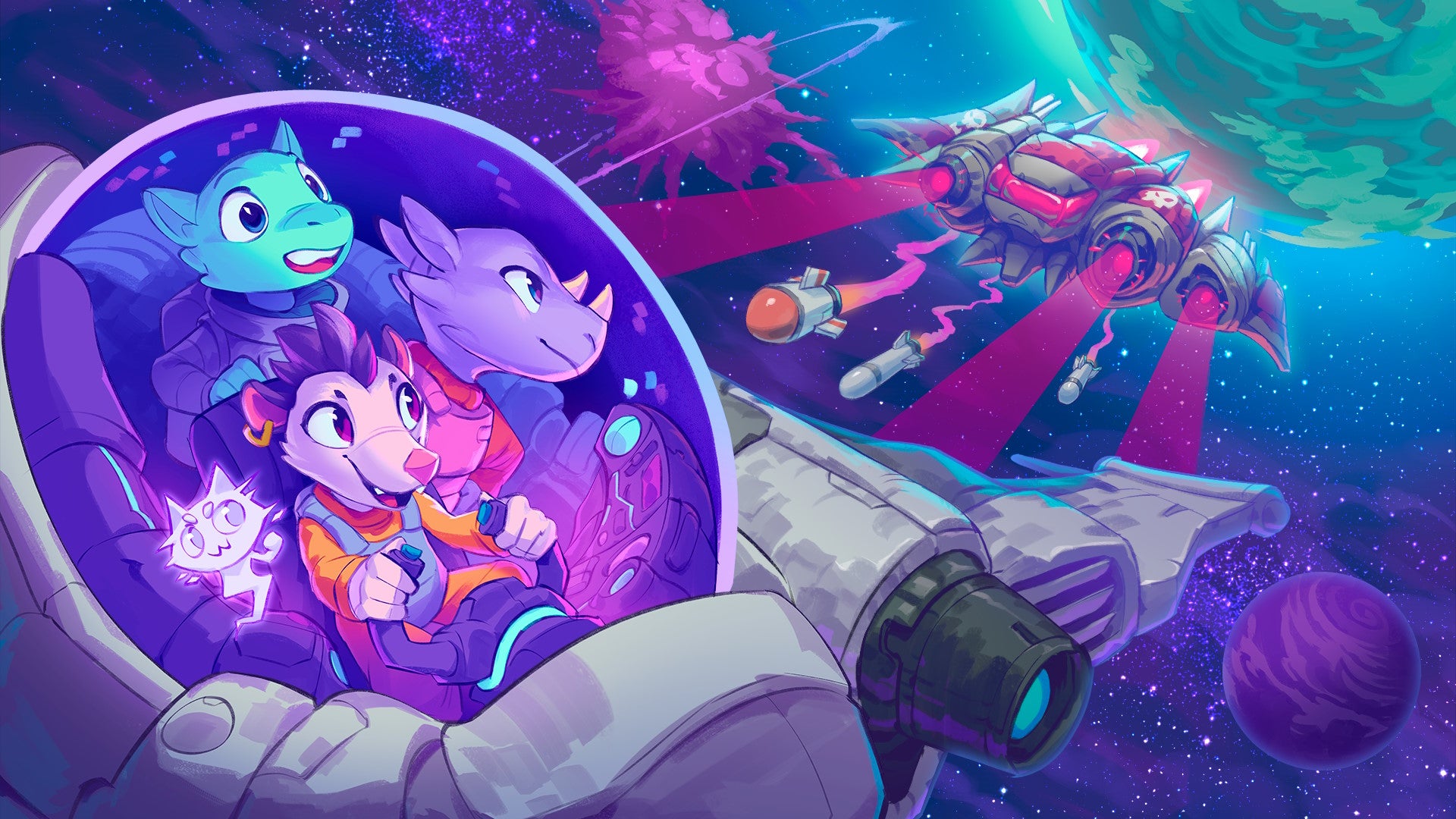
Image credit:Brace Yourself Games

Rocket Rat Games co-founder John Guerra remembers the exact day he started working on Cobalt Core ’s first prototype. He and his fellow co-founder Ben Driscoll had just spent a week playing Daniel Mullins’ mysterious roguelike deckbuilder Inscryption at the end of October 2021, but the combination of a bad storm and a power outage ended up forcing Guerra to decamp from his home in Massachusetts and stay with some family until it all blew over. “I got back late on Halloween, just in time to put out a bowl of candy for some kids, and then the next morning we started Cobalt Core,” he tells me.
The pair had been working on a range of different prototypes in the months leading up to this lightbulb moment. As development on their debut game, the spaceship building puzzler Sunshine Heavy Industries , began winding down, “we were throwing all kinds of stuff at the wall,” he says, including games in 3D, a platformer, with Driscoll revealing they even had “a Terraria -like one for a couple of weeks” with a grid-based world that characters bounced around in. But it was playing Inscryption that brought everything to a head. Both had spent hundreds of hours with Slay The Spire , but “Inscryption proved to us that there was still a lot of space to explore in the genre,” says Guerra. And with increasing calls from Sunshine Heavy Industries players begging them to let them fly the ships they were creating in its shipyard sandbox, “you can kind of see how that went from A to B”.
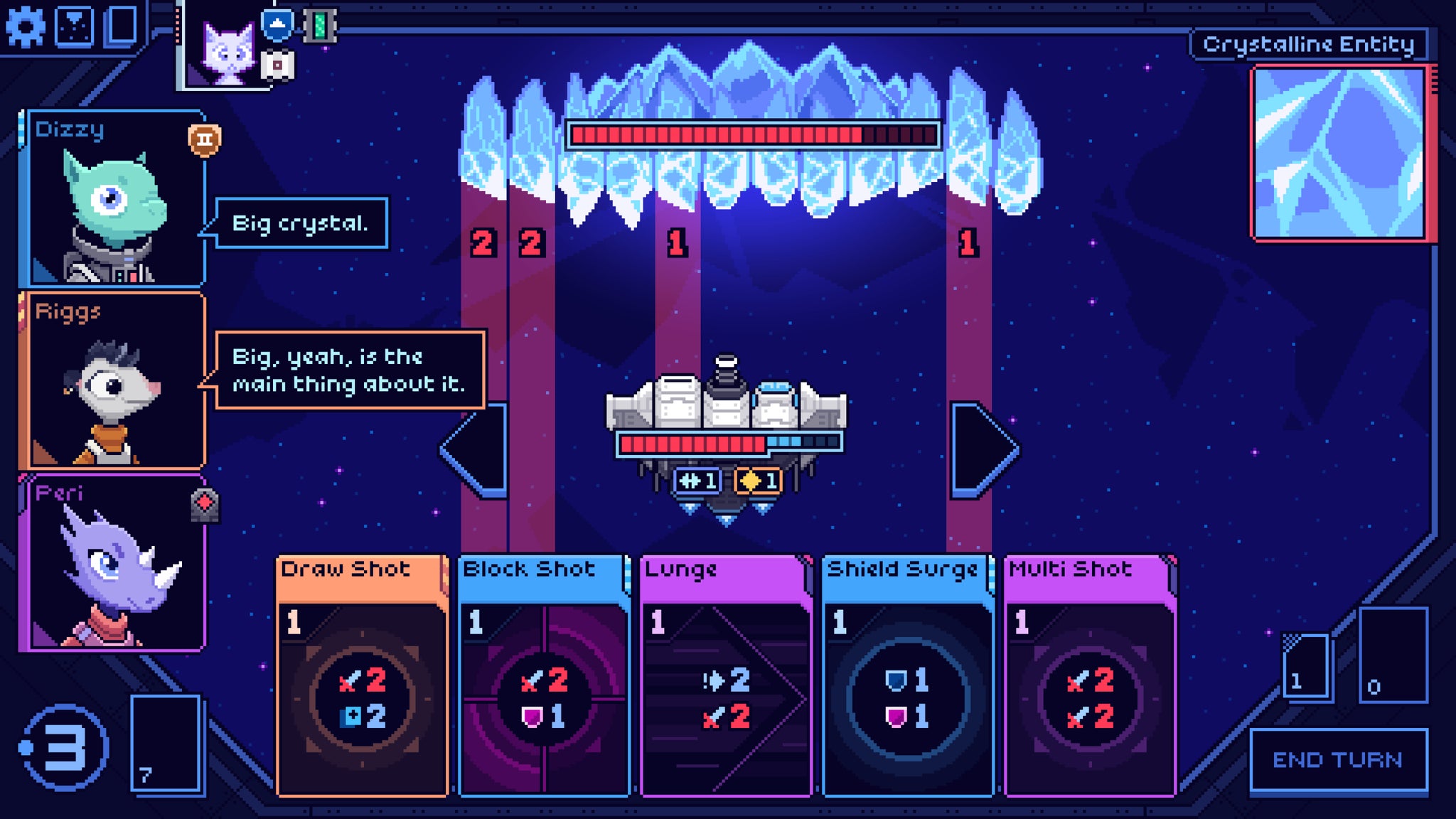
Guerra says they both felt like they’d “had our fill” of designing games like Sunshine Heavy Industries, so “it’s funny that the [prototype] that we ended up landing on looks as similar as it does to our last game.” |Image credit:Rock Paper Shotgun/Rocket Rat Games
Back on November 1st 2021, however, Guerra and Driscoll were still nailing down exactly what that ‘A’ looked like. For Driscoll, who’s based on the opposite side of the US to his development partner, it was the way Inscryption’s cards talked to the player as characters in their own right that captivated him the most. This idea then collided with another one he’d been sitting on, based around “being on the bridge like you’re in Star Trek, and having your characters, who have real stories and things to say, yelling commands at you, or offering you options,” he says. “Like in the game Reigns , where you have cards pop up and you go left or right for a choice. That was the original thing I was thinking about. Then we ended up on the cards, because they were more fun.”
It still wasn’t clear what form these cards would take just yet, but Guerra explains “the second we realised how well those two ideas clicked together, while we were both thinking about cards because of Inscryption, we were like, ‘We have got to dig into this one.’”
But how do you paper prototype a card game when you live on opposite sides of the country? The answer lay in Berserk Games’ Tabletop Simulator , with Driscoll taking on the role of the player, and Guerra acting as the theoretical computer. “That was a really good way of testing really quickly, like, what’s working, what isn’t?” Guerra continues. “We threw out some ideas early on really fast because of that, and we were able to figure out the core of the game, I mean, honestly, it kind of came together within, what, a few days?”
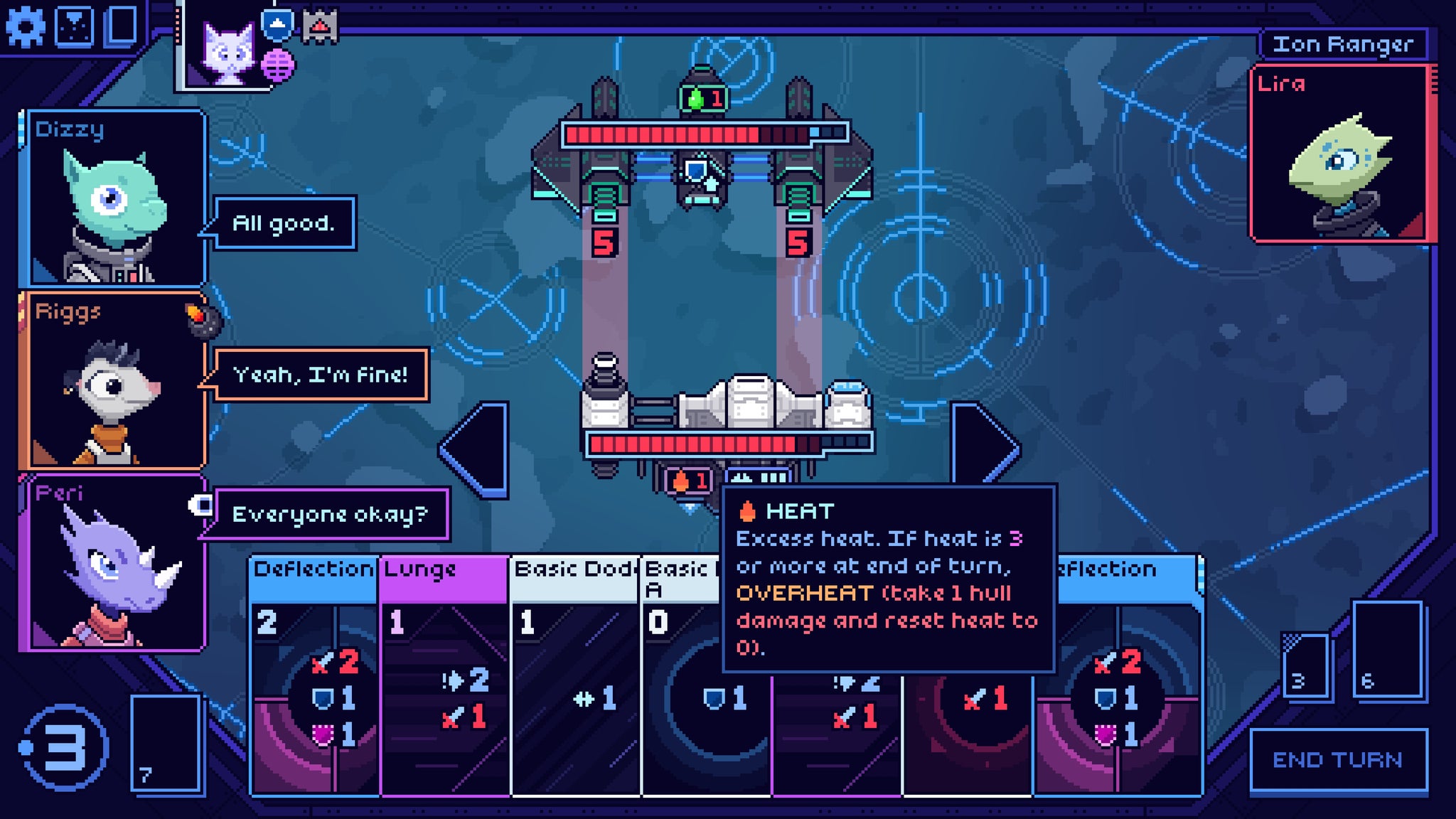
You meet all sorts of creatures on your journey through space, from robots to other mammals and reptiles. |Image credit:Rock Paper Shotgun/Brace Yourself Games
“Yeah, the game landed very quickly,” says Driscoll, “which is why it was the one we picked to finish. It checked all the boxes we wanted narratively and vibe-wise, it made sense for us because we have experience making a game that looks like this and has this character, and it worked mechanically. It’s within a space of games that people know that they like already - people see five cards and are like, ‘Okay, I understand’ - and it was different enough, and had its own character that we’d have fun making the rest of it.”
I ask them what might have happened if Tabletop Simulator hadn’t existed. Would Cobalt Core still have been the same Cobalt Core we know today? “It’s not just that it would have taken longer if we just started coding it from scratch,” says Driscoll. “You might just not end up with the same things. It might be too much work. If you make system A, and then you want to try out system B, but it takes two weeks to do it, you might just be well, like, I’m tired, you know?” he laughs. “But it’s so easy to change it on paper.”
“[Drake’s] like a foil to the vibe of everybody else. Her whole existence is just to be rude.”
With the core of the game starting to take shape, Driscoll then set about drawing its characters, gradually working out who they were and what their role on the ship would be. Dizzy, for example, one of the three starting characters, was originally “much grumpier-looking” with horns and “cool dots on him,” says Driscoll. Eventually they both felt that he simply came across as “a guy who looks tired”, prompting a complete revamp. Drake, meanwhile, who’s one of the later unlockable characters, began life as an enemy, ironically mirroring the exact way she joins your crew in the final game. “I forget why [she became a crew member,” Driscoll chuckles. “We just thought it would be funny if you could play as her because she’s kinda mean, and we don’t have any characters like that. She’s like a foil to the vibe of everybody else. Her whole existence is just to be rude.”
Driscoll also drew plenty of placeholder art for Guerra to use while he worked out the details of the card system, and at one point he tells me there was a “purple slug guy with big eyes” he used for testing out the deck for their seventh playable character. “That guy was very briefly, very briefly occupying one of the player characters,” Guerra laughs, “and then Ben was like, ‘That guy does not deserve that! No, no, no!’”
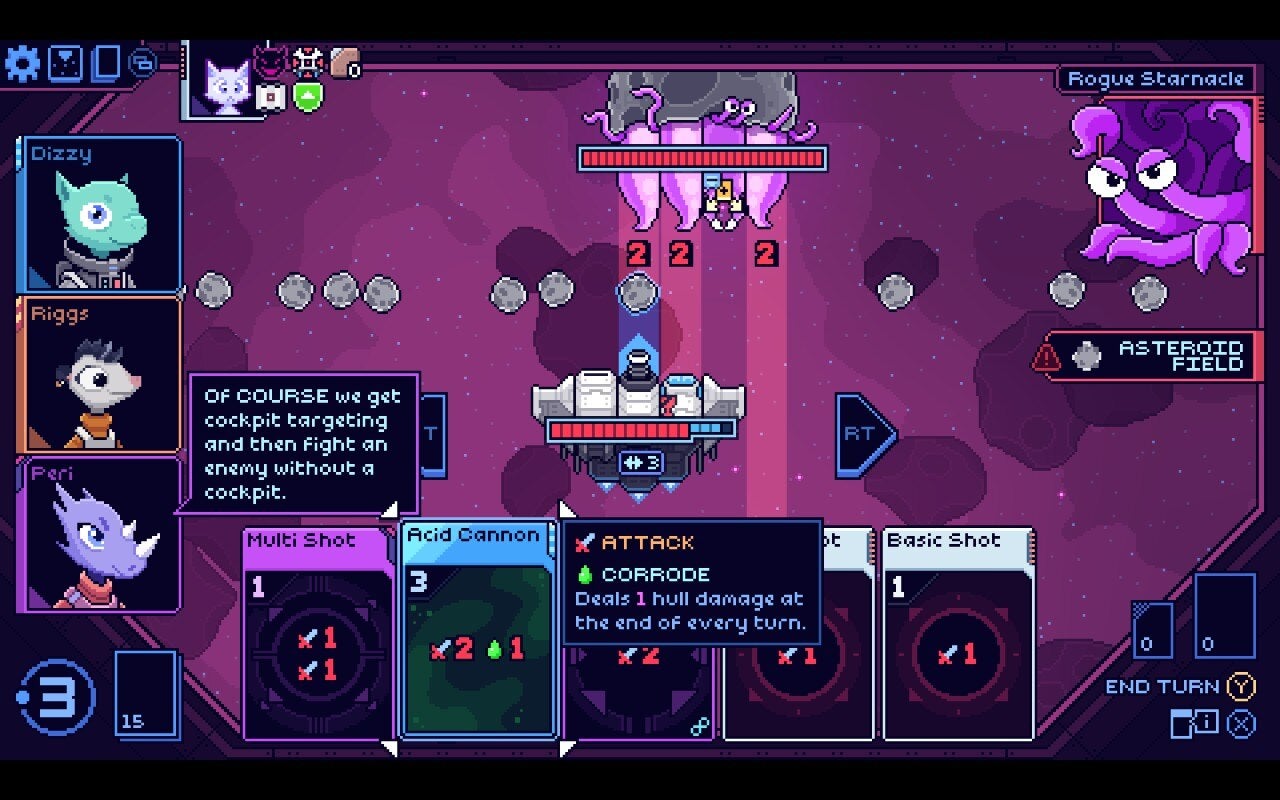
Image credit:Rock Paper Shotgun/Brace Yourself Games
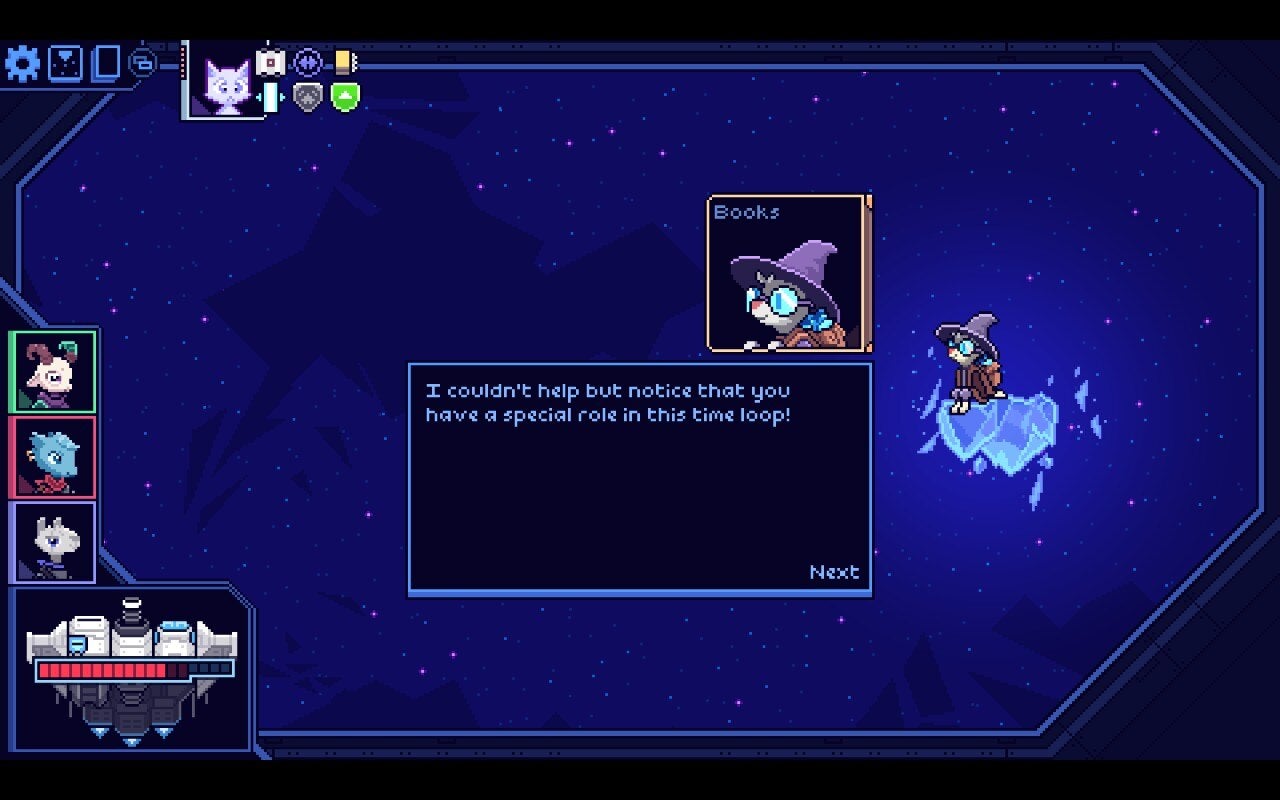
Books (left) does not have an official species, though I’m sure Drake (right) could think of a few withering suggestions. |Image credit:Rock Paper Shotgun/Brace Yourself Games
“At that point, I think we had a conversation that all the characters are all too cute,” Driscoll clarifies. “We already have a cute mammal, we already have a cute possum. If we add another character, we should do, like, a weird one.” Guerra agreed with this assessment, but Driscoll quickly started thinking, “What if I just made like, a little - " He stops himself. “What if I just drew Books instead and put Books in the game? And we were like, ‘Hm, hm, yes, yes.’”
“And you were right!” Guerra chimes in, but Driscoll is quick to address that brief pause, saying, “I almost… We have this running joke, which is we haven’t assigned Books a species, she’s just, like, a critter. I almost described her as a specific animal, which… that can’t get out! She has a hat on, you can’t see what kind of ears she has!”
Some of the enemies you encounter also came from similar, spur of the moment decisions like this, including one of my personal favourites, Brac the Crab. “Brac literally started with Ben saying, ‘I want to draw a crab ship, and do a crab ship,’ and I was like, ‘Great, we’re adding a crab!’” Guerra jokes.
“Nature just keeps making pinchy boys.”
“No, no,” Driscoll says. “The gag was, we were talking about carcinisation, the tendency of nature to make many creatures look like crabs that are not technically like crabs. There are many crabs that are not related to each other. Nature just keeps making, like, pinchy boys, and we thought it would be funny to have two different crab enemies that insist they have no relation to each other, but look very similar. And then we just never made the second,” he laughs.
“Evolutionary Perfection” sounds like Brac’s got a bit of an ego problem… |Image credit:Rock Paper Shotgun/Brace Yourself Games
As more characters started appearing on the scene, though, Guerra says that designing appropriate decks for them became “one of the harder design beats.” They’d always planned to have three characters right from the start, with the intention of adding more later. “[But] when it actually got to the point where we had swapped from ’there are three characters’ to ’there are four plus characters and you choose three’, there was definitely a shifting of gears of like, ‘Oh, shoot, this card doesn’t make any sense anymore if that other thing isn’t there.’”
But it wasn’t just the card synergies that started going awry. They also wanted to have cutscenes to move the story along, but the question then became “how the hell are we going to do [that] if there’s no guarantee that any given character is present on the ship?” Guerra continues. That’s when CAT came in, your ship’s computer. She’s an ever-present force in Cobalt Core, acting as a sort of de facto leader for your crew on each run. However, since she’s also the only character who retains her memories between its roguelike timeloops, she’s also the glue that holds the game’s story together. With her in place, it “cleared up” a lot of problems that Guerra and Driscoll were starting to run into elsewhere, and gave them the surety of always having a constant presence to deliver the game’s main story beats.
“If we didn’t have CAT and every conversation with every person had to have back-ups for all eight characters that need to be present, that would have multiplied our work by a lot,” says Driscoll. “And it probably would have ended in a worse place, because you’re trying to write stuff that isn’t specific enough.”
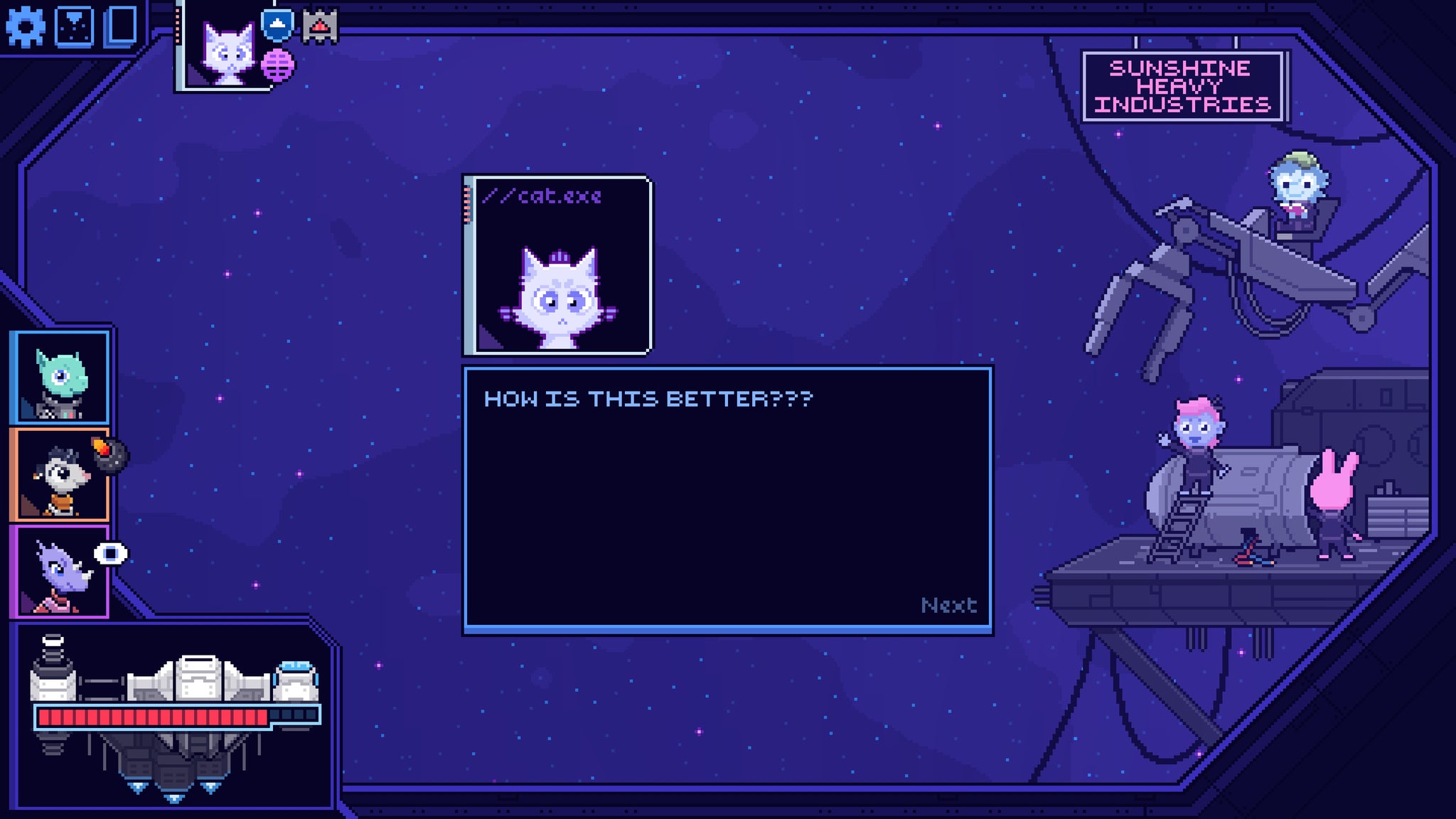
As your ship’s computer, CAT handles a lot of Cobalt Core’s main story beats. Is she the same C.A.T AI that’s also behind Sunshine Heavy Industries’ shipbuilding program, though? Who can say. Both games exist “in the same universe” and are in “linear time with each other,” says Driscoll, but they’re “not particularly connected narratively”. |Image credit:Rock Paper Shotgun/Brace Yourself Games
With CAT on board to do the heavy lifting on the story, it then became the job of the remaining crew members to help bring “more flavour” to Cobalt Core, the goal being to make the world feel just as alive and aware of the player’s place within it as perhaps Inscryption’s sentient cards did. But even though it’s the characters who are doing most of the talking here, Guerra and Driscoll tell me that it’s still technically the cards who are the ones whispering inside the machine here.
“Very little of the game’s dialogue is fired directly from the code,” Driscoll explains. “All the dialogue exists as just a big file organised by conversation, and the conversations have a lot of filters they can use to make themselves get picked by the game at appropriate times.” For example, you might play a card that successfully hits for two damage, and once that turn’s finished and everything “returns to rest,” as Driscoll puts it, the game will sift through that database to find filter out an appropriate response, such as ‘Nice shot!’ for that missile hit or ‘Is everyone okay?’ if you miss and take damage.
“It’s kind of an illusion, because this is a lot of specific stuff that was easy to add, but it makes your characters feel pretty alive and aware of you, which is cool.”
“It’s really easy, relatively speaking, to just put more dialogue in the game [this way] without creating more code,” says Driscoll, and Guerra confirms that “a lot of the hyper specific dialogue kind of worked backwards from that” once that system was in place. “Why not add a shout that [references] ‘if these two characters are on board and you just hit while you have this artefact’?” says Guerra. “There are enough of those in there that I think we keep surprising people with new details that they haven’t seen before, you know, 100 runs in, and I love that.”
“Yeah, there are ones that are specific to synergies that we know exist between two artefacts or something that [when] a character will say it, players are like -” Driscoll throws his hands to his head in a ‘mind-blown’ kind of expression. “It’s kind of an illusion, because this is a lot of specific stuff that was easy to add, but it makes your characters feel pretty alive and aware of you, which is cool.”
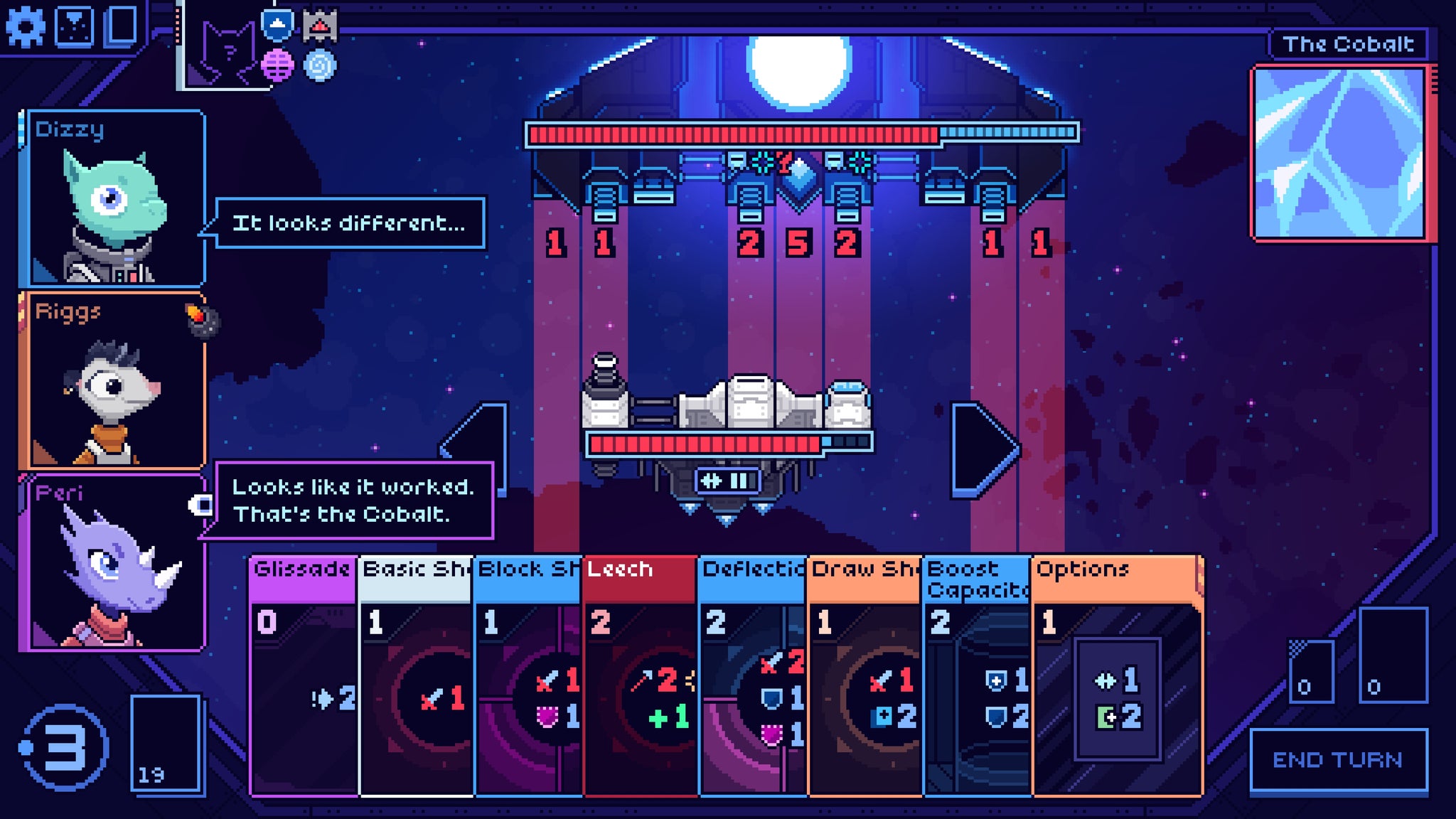
Image credit:Rock Paper Shotgun/Brace Yourself Games
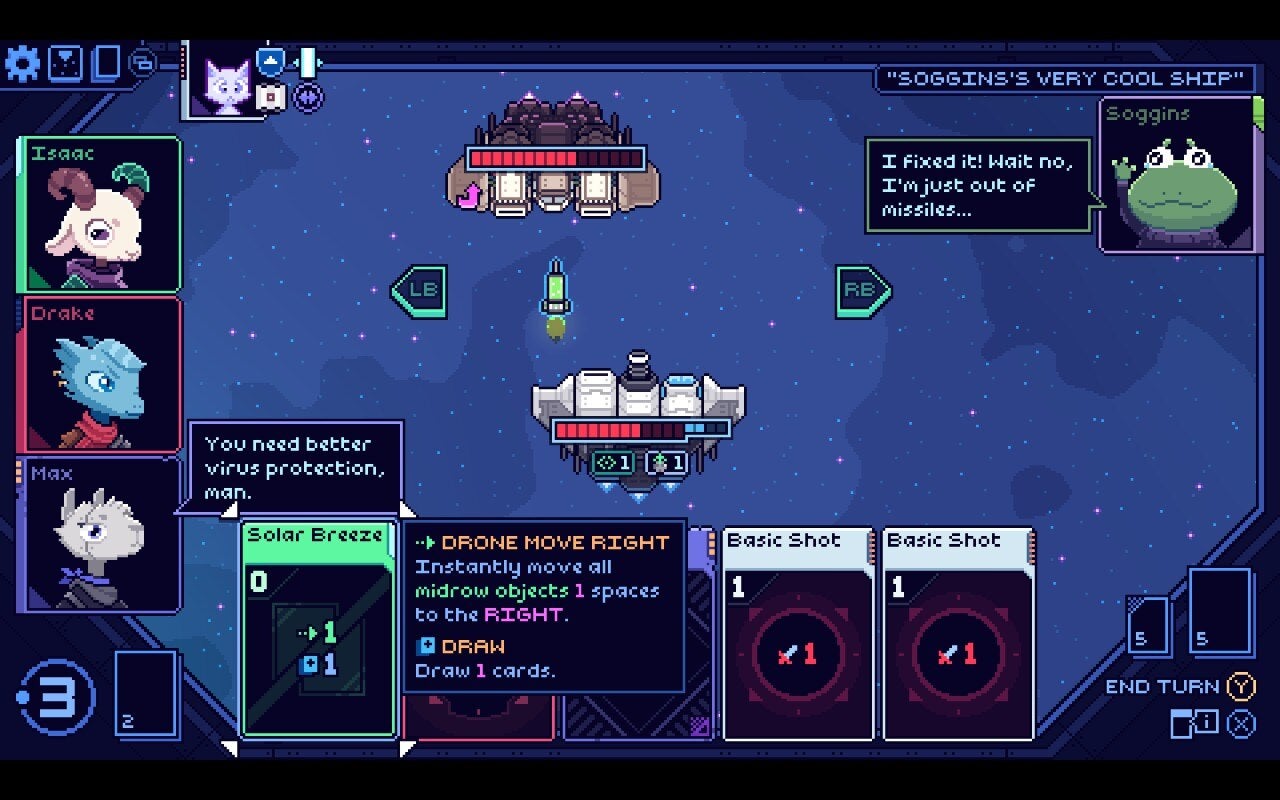
Cobalt Core’s reactive and context-specific dialogue is easily one of my favourite parts of the entire game. |Image credit:Rock Paper Shotgun/Brace Yourself Games
Of course, depending on which characters you pick, the emotional trajectory of that dialogue may be more congratulatory than others, as Guerra admits there are definitely “some teams that are easier or harder than others”. The three starting characters are “arguably the best team composition,” he says, though that’s partly because they were designed first. They also embody " the three game mechanics,” Driscoll adds, citing Dizzy’s specialisation in defence, Riggs being geared around evasion, while Peri, as your weapons officer, is all about attack. “Everything else is just a complication then.”
As for the hardest teams, Guerra and Driscoll have several theories. “Most of the combinations with character eight are intended to be a little bit difficult,” Guerra muses, with Driscoll proposing, “It would probably be ‘Eight’, Max and Books, right?” Then again, “all of the boys - Dizzy, Issac and Max - all kind of lack offensive power, and that gets kind of tricky [as well],” says Guerra. Fundamentally, though, “every team comp is viable,” Guerra stresses. “We’ve seen somewhere between five and ten people now post screenshots of ‘Hey, I have officially beaten every team comp on the hardest difficulty,’ which is awesome. I love that there’s a place that they can challenge themselves there.”
At the same time, Driscoll and Guerra were both adamant about Cobalt Core having a clear and definitive ending. “That was an intentional choice,” says Guerra, partly because they both find games with endings more satisfying on a personal level, but also because, as designers, accounting for ever-increasing meta-progression simply isn’t as compelling to them. “I find it more interesting to design the game under the assumption that you’re exactly as strong on run one as you are on run 100,” says Guerra, though he’s keen to stress that he’s “not dunking on anyone who’s doing the opposite”. Rather, “if I understand exactly how strong a player could be at the end of act two, then I can make a tightly honed second boss. Whereas, if it’s like, ‘oh, at this point in the game, the player has gained anywhere from one to 100 extra max health, it’s like, ‘I don’t know! I don’t know how much damage it should do…’”
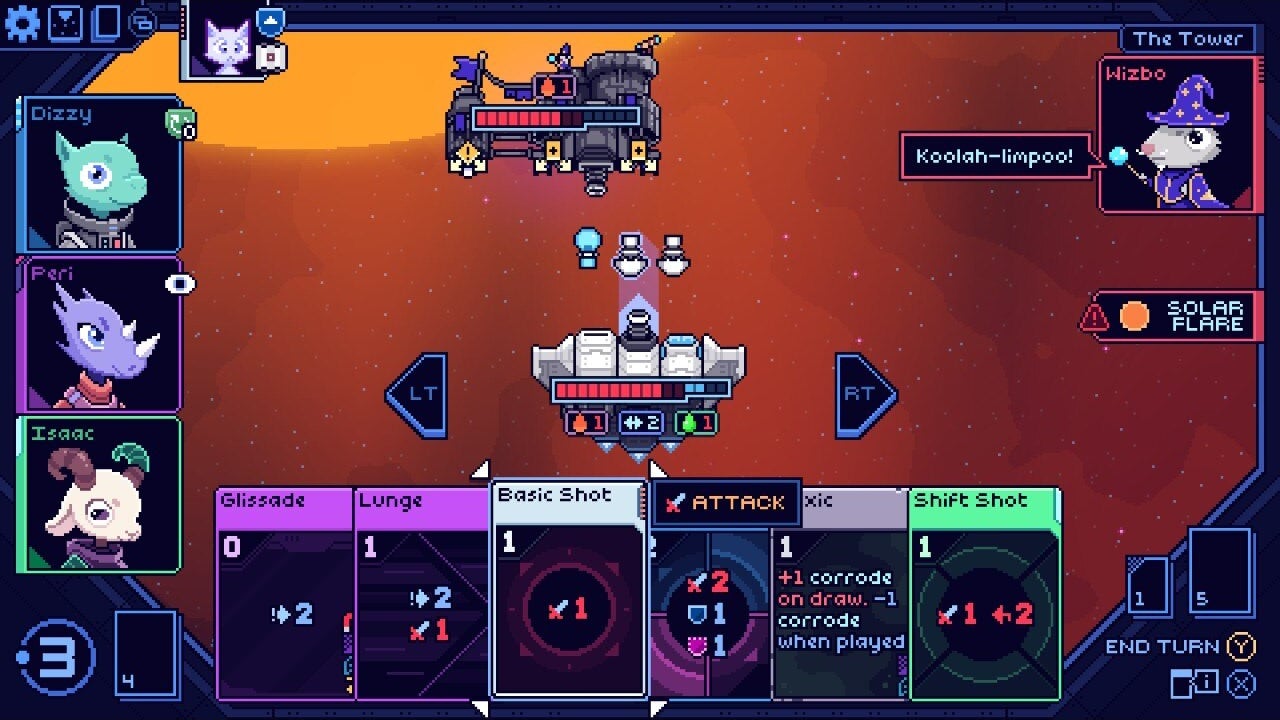
Blessed Wizbo. |Image credit:Rock Paper Shotgun/Brace Yourself Games
Driscoll concurs, saying that the only “small exceptions” to this rule are in service of making the game easier to learn - and, of course, to deliver a good punchline in the process. “I think it’s a couple of victories until Wizbo shows up,” he gives as an example, “and that’s just because we watched our friend play, and the first event he got was Wizbo. And if you don’t know the context of the game - a sci-fi game at the core - then getting a wizard as your first enemy is, like, you’re missing the joke. Why is there a wizard in space? But that’s funnier if it’s the third or fourth round. You see a wizard and you’re like, ‘What? Who are you?’ Aside from stuff like that, the game is basically meta-progression free except for unlocking new characters.”
So what’s next for Rocket Rat Games? A well-deserved rest, by the sound of things. “We’ve been trying to play future stuff a little bit close to the chest, just because, honestly, we worked really, really, really hard for a long time before launch, and now we’re not trying to make any promises,” says Guerra. “I’m taking my time and it’s nice.” The pair are definitely “sticking together”, though, saying they’d also like to add alternate bosses and “probably some sort of daily mode” to Cobalt Core in the future.
“We are going to make a third thing, though,” Guerra teases. He’s not sure when, though this is likely because he’s currently playing every Final Fantasy game in order - he’s on V right now - as well as likely catching up on Klei Entertainment’s Griftlands , which he says he “specifically didn’t play” during Cobalt ’s Core’s development, just in case it interfered with his own design ideas. “We like making new stories,” Driscoll concludes. “I’m not saying we wouldn’t make a Cobalt Core 2, but if we made another game, we wouldn’t want to probably write about the same characters.” Unless, of course, it’s Books, or Sunshine Heavy Industries’ shipyard mistress Selene, who also makes a repeat appearance as Cobalt Core’s resident ship tinkerer. Then all bets are off.
“Books seems like enough of a misfit in the Cobalt Core universe that she’d be likely to show up in something else,” says Driscoll, and Guerra agrees: “If our next game was like a 3D game set in medieval years or whatever, we would still just be like, ‘Yeah, whatever, and Selene shows up. She runs a wagon building industry in this one.’ If we’re having fun, you know, it’s a playful space.”

Cobalt Core
Video Game
Rock Paper Shotgun is better when you sign in
Sign in and join us on our journey to discover strange and compelling PC games.

All 75 Arc Raiders Blueprints and where to get them
These areas have the highest chance of giving you Blueprints
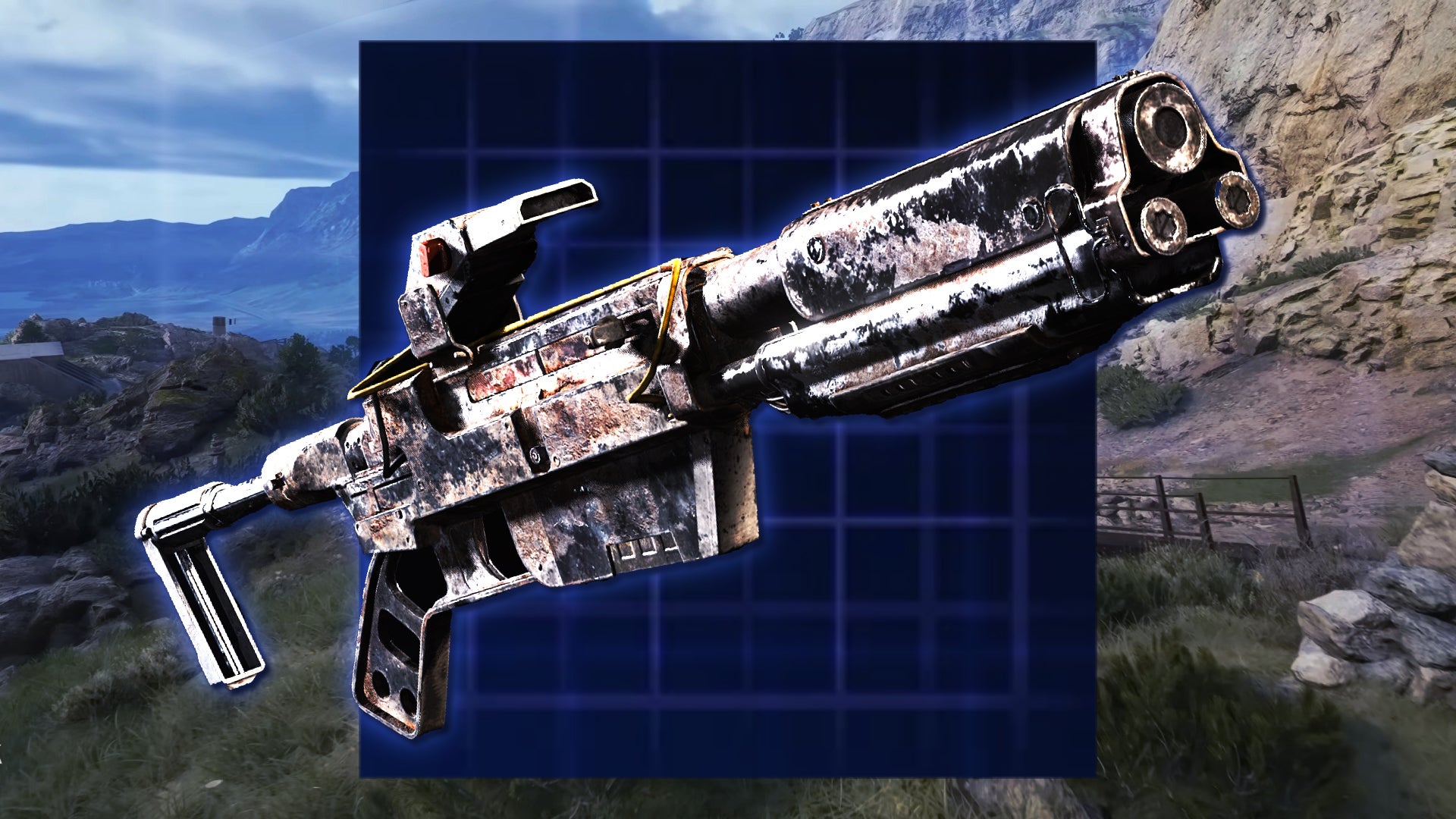
Image credit:Rock Paper Shotgun/Embark Studios

Looking for more Arc Raiders Blueprints? It’s a special day when you find a Blueprint, as they’re among the most valuable items in Arc Raiders. If you find a Blueprint that you haven’t already found, then you must make sure you hold onto it at all costs, because Blueprints are the key to one of the most important and powerful systems of meta-progression in the game.
This guide aims to be the very best guide on Blueprints you can find, starting with a primer on what exactly they are and how they work in Arc Raiders, before delving into exactly where to get Blueprints and the very best farming spots for you to take in your search.
We’ll also go over how to get Blueprints from other unlikely activities, such as destroying Surveyors and completing specific quests. And you’ll also find the full list of all 75 Blueprints in Arc Raiders on this page (including the newest Blueprints added with the Cold Snap update , such as the Deadline Blueprint and Firework Box Blueprint), giving you all the information you need to expand your own crafting repertoire.
In this guide:
- What are Blueprints in Arc Raiders?
- Full Blueprint list: All crafting recipes
- Where to find Blueprints in Arc Raiders Blueprints obtained from quests Blueprints obtained from Trials Best Blueprint farming locations

What are Blueprints in Arc Raiders?
Blueprints in Arc Raiders are special items which, if you manage to extract with them, you can expend to permanently unlock a new crafting recipe in your Workshop. If you manage to extract from a raid with an Anvil Blueprint, for example, you can unlock the ability to craft your very own Anvil Pistol, as many times as you like (as long as you have the crafting materials).
To use a Blueprint, simply open your Inventory while in the lobby, then right-click on the Blueprint and click “Learn And Consume” . This will permanently unlock the recipe for that item in your Workshop. As of the Stella Montis update, there are allegedly 75 different Blueprints to unlock - although only 68 are confirmed to be in the game so far. You can see all the Blueprints you’ve found and unlocked by going to the Workshop menu, and hitting “R” to bring up the Blueprint screen.
It’s possible to find duplicates of past Blueprints you’ve already unlocked. If you find these, then you can either sell them, or - if you like to play with friends - you can take it into a match and gift it to your friend so they can unlock that recipe for themselves. Another option is to keep hold of them until the time comes to donate them to the Expedition.
Full Blueprint list: All crafting recipes
Below is the full list of all the Blueprints that are currently available to find in Arc Raiders, and the crafting recipe required for each item:
| Blueprint | Type | Recipe | Crafted At |
|---|---|---|---|
| Bettina | Weapon | 3x Advanced Mechanical Components 3x Heavy Gun Parts 3x Canister | Gunsmith 3 |
| Blue Light Stick | Quick Use | 3x Chemicals | Utility Station 1 |
| Aphelion | Weapon | 3x Magnetic Accelerator 3x Complex Gun Parts 1x Matriarch Reactor | Gunsmith 3 |
| Combat Mk. 3 (Flanking) | Augment | 2x Advanced Electrical Components 3x Processor | Gear Bench 3 |
| Combat Mk. 3 (Aggressive) | Augment | 2x Advanced Electrical Components 3x Processor | Gear Bench 3 |
| Complex Gun Parts | Material | 2x Light Gun Parts 2x Medium Gun Parts 2x Heavy Gun Parts | Refiner 3 |
| Fireworks Box | Quick Use | 1x Explosive Compound 3x Pop Trigger | Explosives Station 2 |
| Gas Mine | Mine | 4x Chemicals 2x Rubber Parts | Explosives Station 1 |
| Green Light Stick | Quick Use | 3x Chemicals | Utility Station 1 |
| Pulse Mine | Mine | 1x Crude Explosives 1x Wires | Explosives Station 1 |
| Seeker Grenade | Grenade | 1x Crude Explosives 2x ARC Alloy | Explosives Station 1 |
| Looting Mk. 3 (Survivor) | Augment | 2x Advanced Electrical Components 3x Processor | Gear Bench 3 |
| Angled Grip II | Mod | 2x Mechanical Components 3x Duct Tape | Gunsmith 2 |
| Angled Grip III | Mod | 2x Mod Components 5x Duct Tape | Gunsmith 3 |
| Hullcracker | Weapon | 1x Magnetic Accelerator 3x Heavy Gun Parts 1x Exodus Modules | Gunsmith 3 |
| Launcher Ammo | Ammo | 5x Metal Parts 1x Crude Explosives | Workbench 1 |
| Anvil | Weapon | 5x Mechanical Components 5x Simple Gun Parts | Gunsmith 2 |
| Anvil Splitter | Mod | 2x Mod Components 3x Processor | Gunsmith 3 |
| ??? | ??? | ??? | ??? |
| Barricade Kit | Quick Use | 1x Mechanical Components | Utility Station 2 |
| Blaze Grenade | Grenade | 1x Explosive Compound 2x Oil | Explosives Station 3 |
| Bobcat | Weapon | 3x Advanced Mechanical Components 3x Light Gun Parts | Gunsmith 3 |
| Osprey | Weapon | 2x Advanced Mechanical Components 3x Medium Gun Parts 7x Wires | Gunsmith 3 |
| Burletta | Weapon | 3x Mechanical Components 3x Simple Gun Parts | Gunsmith 1 |
| Compensator II | Mod | 2x Mechanical Components 4x Wires | Gunsmith 2 |
| Compensator III | Mod | 2x Mod Components 8x Wires | Gunsmith 3 |
| Defibrillator | Quick Use | 9x Plastic Parts 1x Moss | Medical Lab 2 |
| ??? | ??? | ??? | ??? |
| Equalizer | Weapon | 3x Magnetic Accelerator 3x Complex Gun Parts 1x Queen Reactor | Gunsmith 3 |
| Extended Barrel | Mod | 2x Mod Components 8x Wires | Gunsmith 3 |
| Extended Light Mag II | Mod | 2x Mechanical Components 3x Steel Spring | Gunsmith 2 |
| Extended Light Mag III | Mod | 2x Mod Components 5x Steel Spring | Gunsmith 3 |
| Extended Medium Mag II | Mod | 2x Mechanical Components 3x Steel Spring | Gunsmith 2 |
| Extended Medium Mag III | Mod | 2x Mod Components 5x Steel Spring | Gunsmith 3 |
| Extended Shotgun Mag II | Mod | 2x Mechanical Components 3x Steel Spring | Gunsmith 2 |
| Extended Shotgun Mag III | Mod | 2x Mod Components 5x Steel Spring | Gunsmith 3 |
| Remote Raider Flare | Quick Use | 2x Chemicals 4x Rubber Parts | Utility Station 1 |
| Heavy Gun Parts | Material | 4x Simple Gun Parts | Refiner 2 |
| Venator | Weapon | 2x Advanced Mechanical Components 3x Medium Gun Parts 5x Magnet | Gunsmith 3 |
| Il Toro | Weapon | 5x Mechanical Components 6x Simple Gun Parts | Gunsmith 1 |
| Jolt Mine | Mine | 1x Electrical Components 1x Battery | Explosives Station 2 |
| Explosive Mine | Mine | 1x Explosive Compound 1x Sensors | Explosives Station 3 |
| Jupiter | Weapon | 3x Magnetic Accelerator 3x Complex Gun Parts 1x Queen Reactor | Gunsmith 3 |
| Light Gun Parts | Material | 4x Simple Gun Parts | Refiner 2 |
| Lightweight Stock | Mod | 2x Mod Components 5x Duct Tape | Gunsmith 3 |
| Lure Grenade | Grenade | 1x Speaker Component 1x Electrical Components | Utility Station 2 |
| Medium Gun Parts | Material | 4x Simple Gun Parts | Refiner 2 |
| Torrente | Weapon | 2x Advanced Mechanical Components 3x Medium Gun Parts 6x Steel Spring | Gunsmith 3 |
| Muzzle Brake II | Mod | 2x Mechanical Components 4x Wires | Gunsmith 2 |
| Muzzle Brake III | Mod | 2x Mod Components 8x Wires | Gunsmith 3 |
| Padded Stock | Mod | 2x Mod Components 5x Duct Tape | Gunsmith 3 |
| Shotgun Choke II | Mod | 2x Mechanical Components 4x Wires | Gunsmith 2 |
| Shotgun Choke III | Mod | 2x Mod Components 8x Wires | Gunsmith 3 |
| Shotgun Silencer | Mod | 2x Mod Components 8x Wires | Gunsmith 3 |
| Showstopper | Grenade | 1x Advanced Electrical Components 1x Voltage Converter | Explosives Station 3 |
| Silencer I | Mod | 2x Mechanical Components 4x Wires | Gunsmith 2 |
| Silencer II | Mod | 2x Mod Components 8x Wires | Gunsmith 3 |
| Snap Hook | Quick Use | 2x Power Rod 3x Rope 1x Exodus Modules | Utility Station 3 |
| Stable Stock II | Mod | 2x Mechanical Components 3x Duct Tape | Gunsmith 2 |
| Stable Stock III | Mod | 2x Mod Components 5x Duct Tape | Gunsmith 3 |
| Tagging Grenade | Grenade | 1x Electrical Components 1x Sensors | Utility Station 3 |
| Tempest | Weapon | 3x Advanced Mechanical Components 3x Medium Gun Parts 3x Canister | Gunsmith 3 |
| Trigger Nade | Grenade | 2x Crude Explosives 1x Processor | Explosives Station 2 |
| Vertical Grip II | Mod | 2x Mechanical Components 3x Duct Tape | Gunsmith 2 |
| Vertical Grip III | Mod | 2x Mod Components 5x Duct Tape | Gunsmith 3 |
| Vita Shot | Quick Use | 2x Antiseptic 1x Syringe | Medical Lab 3 |
| Vita Spray | Quick Use | 3x Antiseptic 1x Canister | Medical Lab 3 |
| Vulcano | Weapon | 1x Magnetic Accelerator 3x Heavy Gun Parts 1x Exodus Modules | Gunsmith 3 |
| Wolfpack | Grenade | 2x Explosive Compound 2x Sensors | Explosives Station 3 |
| Red Light Stick | Quick Use | 3x Chemicals | Utility Station 1 |
| Smoke Grenade | Grenade | 14x Chemicals 1x Canister | Utility Station 2 |
| Deadline | Mine | 3x Explosive Compound 2x ARC Circuitry | Explosives Station 3 |
| Trailblazer | Grenade | 1x Explosive Compound 1x Synthesized Fuel | Explosives Station 3 |
| Tactical Mk. 3 (Defensive) | Augment | 2x Advanced Electrical Components 3x Processor | Gear Bench 3 |
| Tactical Mk. 3 (Healing) | Augment | 2x Advanced Electrical Components 3x Processor | Gear Bench 3 |
| Yellow Light Stick | Quick Use | 3x Chemicals | Utility Station 1 |
Note: The missing Blueprints in this list likely have not actually been added to the game at the time of writing, because none of the playerbase has managed to find any of them. As they are added to the game, I will update this page with the most relevant information so you know exactly how to get all 75 Arc Raiders Blueprints.
Where to find Blueprints in Arc Raiders
Below is a list of all containers, modifiers, and events which maximise your chances of finding Blueprints:
- Certain quests reward you with specific Blueprints .
- Completing Trials has a high chance of offering Blueprints as rewards.
- Surveyors have a decent chance of dropping Blueprints on death.
- High loot value areas tend to have a greater chance of spawning Blueprints.
- Night Raids and Storms may increase rare Blueprint spawn chances in containers.
- Containers with higher numbers of items may have a higher tendency to spawn Blueprints. As a result, Blue Gate (which has many “large” containers containing multiple items) may give you a higher chance of spawning Blueprints.
- Raider containers (Raider Caches, Weapon Boxes, Medical Bags, Grenade Tubes) have increased Blueprint drop rates. As a result, the Uncovered Caches event gives you a high chance of finding Blueprints.
- Security Lockers have a higher than average chance of containing Blueprints.
- Certain Blueprints only seem to spawn under specific circumstances: Tempest Blueprint only spawns during Night Raid events. Vulcano Blueprint only spawns during Hidden Bunker events. Jupiter and Equaliser Blueprints only spawn during Harvester events.
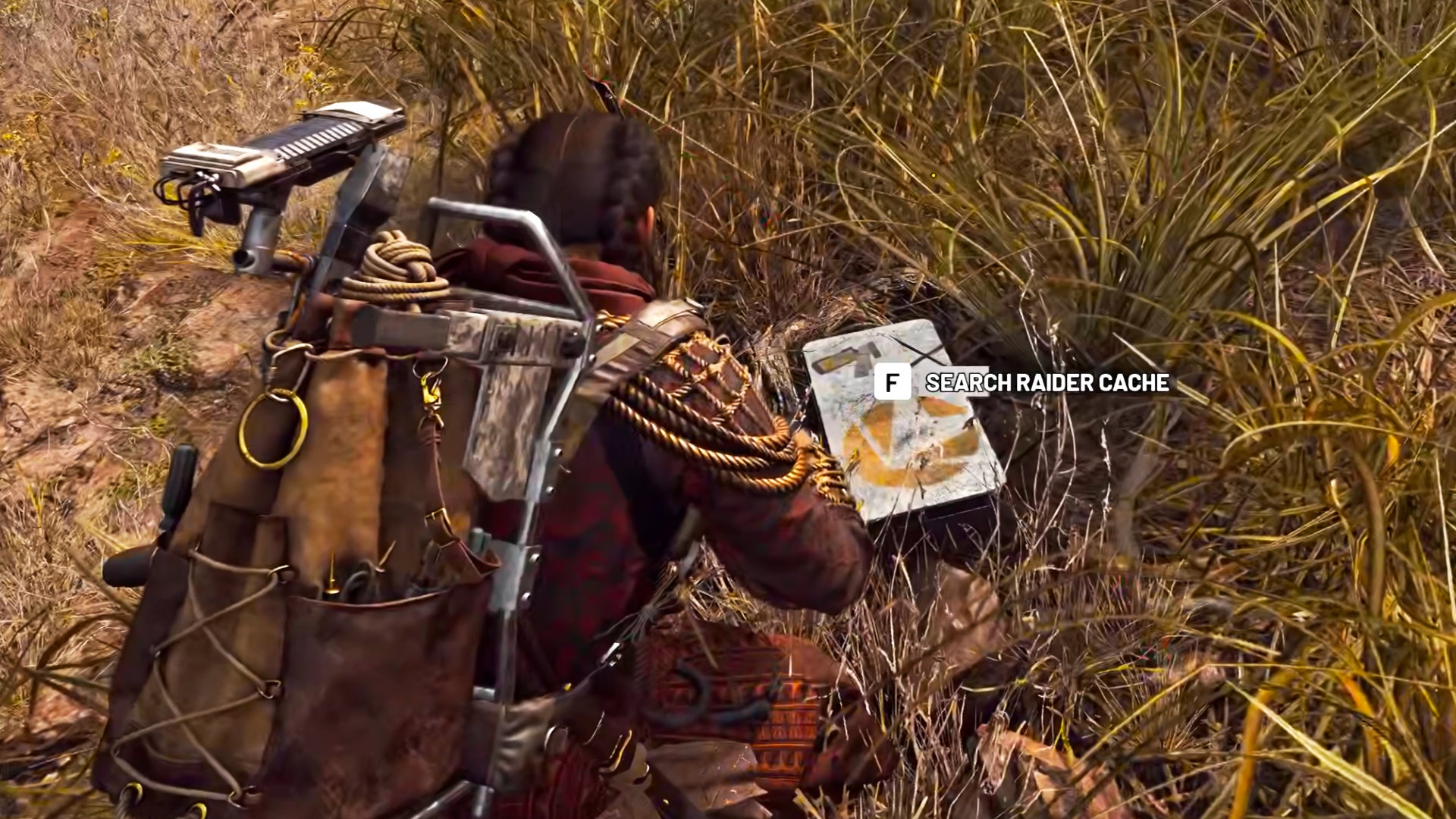
Raider Caches, Weapon Boxes, and other raider-oriented container types have a good chance of offering Blueprints. |Image credit:Rock Paper Shotgun/Embark Studios
Blueprints have a very low chance of spawning in any container in Arc Raiders, around 1-2% on average. However, there is a higher chance of finding Blueprints in particular container types. Specifically, you can find more Blueprints in Raider containers and security lockers.
Beyond this, if you’re looking for Blueprints you should focus on regions of the map which are marked as having particularly high-value loot. Areas such as the Control Tower in Dam Battlegrounds, the Arrival and Departure Buildings in Spaceport, and Pilgrim’s Peak in Blue Gate all have a better-than-average chance of spawning Blueprints somewhere amongst all their containers. Night Raids and Electromagnetic Storm events also increase the drop chances of certain Blueprints .
In addition to these containers, you can often loot Blueprints from destroyed Surveyors - the largest of the rolling ball ARC. Surveyors are more commonly found on the later maps - Spaceport and Blue Gate - and if one spawns in your match, you’ll likely see it by the blue laser beam that it casts into the sky while “surveying”.
Surveyors are quite well-armoured and will very speedily run away from you once it notices you, but if you can take one down then make sure you loot all its parts for a chance of obtaining certain unusual Blueprints.
Blueprints obtained from quests
One way in which you can get Blueprints is by completing certain quests for the vendors in Speranza. Some quests will reward you with a specific item Blueprint upon completion, so as long as you work through all the quests in Arc Raiders, you are guaranteed those Blueprints.
Here is the full list of all Blueprints you can get from quest rewards:
- Trigger Nade Blueprint: Rewarded after completing “Sparks Fly”.
- Lure Grenade Blueprint: Rewarded after completing “Greasing Her Palms”.
- Burletta Blueprint: Rewarded after completing “Industrial Espionage”.
- Hullcracker Blueprint (and Launcher Ammo Blueprint): Rewarded after completing “The Major’s Footlocker”.
Alas, that’s only 4 Blueprints out of a total of 75 to unlock, so for the vast majority you will need to find them yourself during a raid. If you’re intent on farming Blueprints, then it’s best to equip yourself with cheap gear in case you lose it, but don’t use a free loadout because then you won’t get a safe pocket to stash any new Blueprint you find. No pain in Arc Raiders is sharper than failing to extract with a new Blueprint you’ve been after for a dozen hours already.
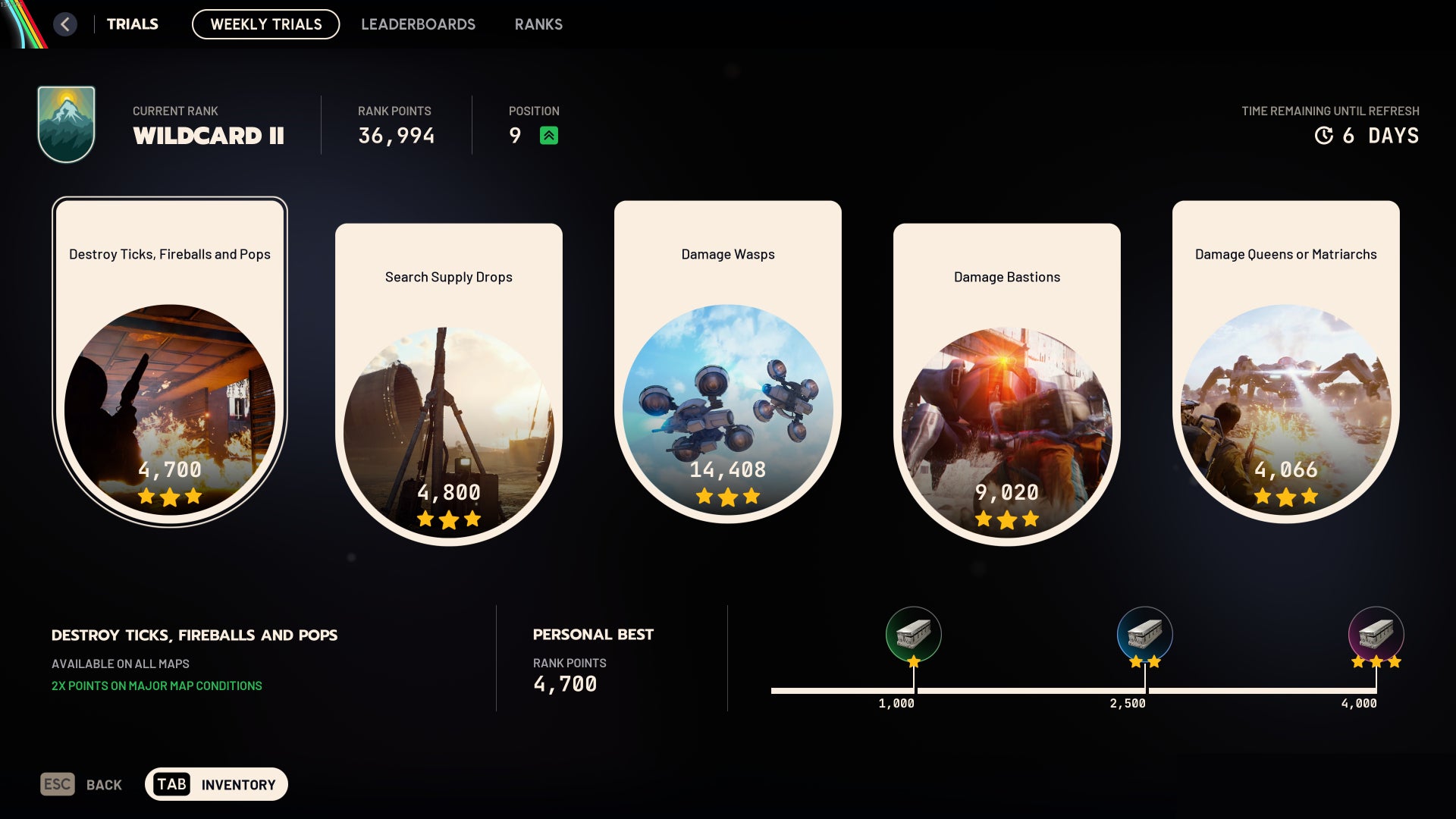
One of the best ways to get Blueprints is by hitting three stars on all five Trials every week. |Image credit:Rock Paper Shotgun/Embark Studios
Blueprints obtained from Trials
One of the very best ways to get Blueprints is as rewards for completing Trials in Arc Raiders. Trials are unlocked from Level 15 onwards, and allow you to earn rewards by focusing on certain tasks over the course of several raids. For example, one Trial might task you with dealing damage to Hornets, while another might challenge you to loot Supply Drops.
Trials refresh on a weekly basis, with a new week bringing five new Trials. Each Trial can offer up to three rewards after passing certain score milestones, and it’s possible to receive very high level loot from these reward crates - including Blueprints. So if you want to unlock as many Blueprints as possible, you should make a point of completing as many Trials as possible each week.
Best Blueprint farming locations
The very best way to get Blueprints is to frequent specific areas of the maps which combine high-tier loot pools with the right types of containers to search. Here are my recommendations for where to find Blueprints on every map, so you can always keep the search going for new crafting recipes to unlock.
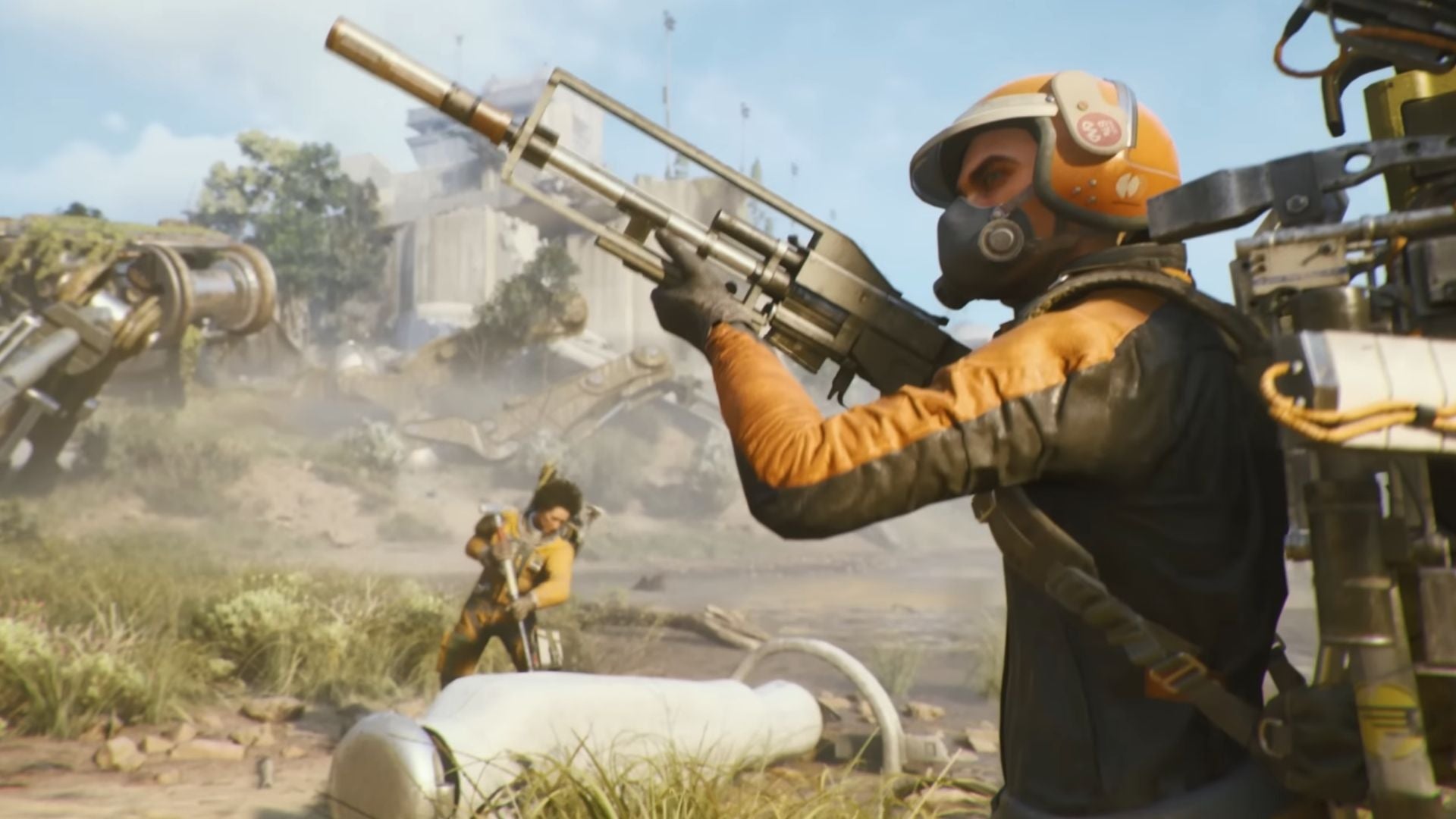
Image credit:Rock Paper Shotgun/Embark Studios
Dam Battlegrounds
The best places to farm Blueprints on Dam Battlegrounds are the Control Tower, Power Generation Complex, Ruby Residence, and Pale Apartments . The first two regions, despite only being marked on the map as mid-tier loot, contain a phenomenal number of containers to loot. The Control Tower can also contain a couple of high-tier Security Lockers - though of course, you’ll need to have unlocked the Security Breach skill at the end of the Survival tree.
There’s also a lot of reporting amongst the playerbase that the Residential areas in the top-left of the map - Pale Apartments and Ruby Residence - give you a comparatively strong chance of finding Blueprints. Considering their size, there’s a high density of containers to loot in both locations, and they also have the benefit of being fairly out of the way. So you’re more likely to have all the containers to yourself.
Buried City
The best Blueprint farming locations on Buried City are the Santa Maria Houses, Grandioso Apartments, Town Hall, and the various buildings of the New District . Grandioso Apartments has a lower number of containers than the rest, but a high chance of spawning weapon cases - which have good Blueprint drop rates. The others are high-tier loot areas, with plenty of lootable containers - including Security Lockers.
Spaceport
The best places to find Blueprints on Spaceport are the Arrival and Departure Buildings, as well as Control Tower A6 and the Launch Towers . All these areas are labelled as high-value loot regions, and many of them are also very handily connected to one another by the Spaceport wall, which you can use to quickly run from one area to the next. At the tops of most of these buildings you’ll find at least one Security Locker, so this is an excellent farming route for players looking to find Blueprints.
The downside to looting Blueprints on Spaceport is that all these areas are hotly contested, particularly in Duos and Squads. You’ll need to be very focused and fast in order to complete the full farming route.
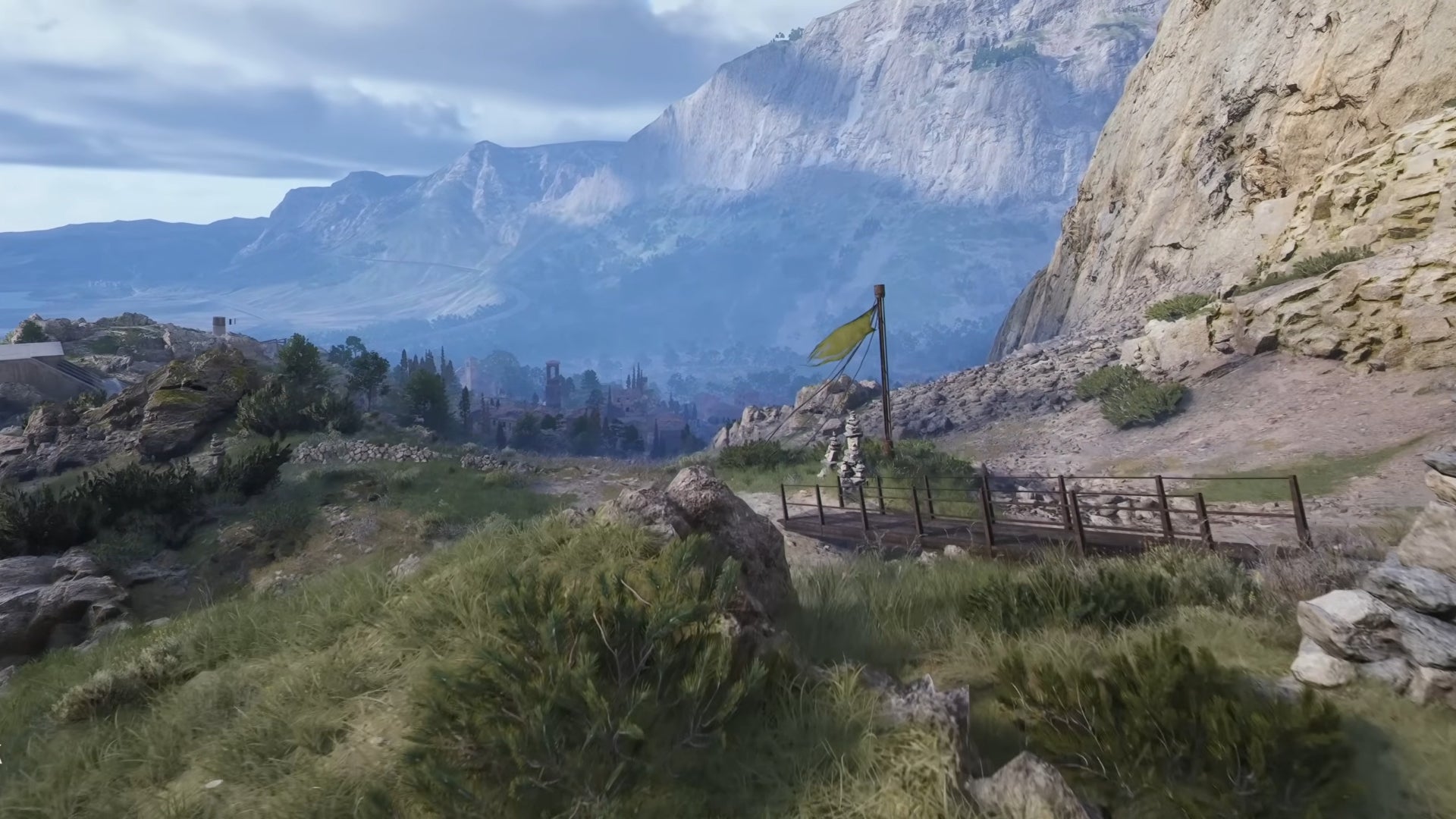
Image credit:Rock Paper Shotgun/Embark Studios
Blue Gate
Blue Gate tends to have a good chance of dropping Blueprints, potentially because it generally has a high number of containers which can hold lots of items; so there’s a higher chance of a Blueprint spawning in each container. In my experience, the best Blueprint farming spots on Blue Gate are Pilgrim’s Peak, Raider’s Refuge, the Ancient Fort, and the Underground Complex beneath the Warehouse .
All of these areas contain a wealth of containers to loot. Raider’s Refuge has less to loot, but the majority of the containers in and around the Refuge are raider containers, which have a high chance of containing Blueprints - particularly during major events.
Stella Montis
On the whole, Stella Montis seems to have a very low drop rate for Blueprints (though a high chance of dropping other high-tier loot). If you do want to try farming Blueprints on this map, the best places to find Blueprints in Stella Montis are Medical Research, Assembly Workshop, and the Business Center . These areas have the highest density of containers to loot on the map.
In addition to this, the Western Tunnel has a few different Security Lockers to loot, so while there’s very little to loot elsewhere in this area of the map, it’s worth hitting those Security Lockers if you spawn there at the start of a match.
That wraps up this primer on how to get all the Blueprints in Arc Raiders as quickly as possible. With the Expedition system constantly resetting a large number of players’ Blueprints, it’s more important than ever to have the most up-to-date information on where to find all these Blueprints.
While you’re here, be sure to check out our Arc Raiders best guns tier list , as well as our primers on the best skills to unlock and all the different Field Depot locations on every map.
ARC Raiders
PS5 , Xbox Series X/S , PC
Rock Paper Shotgun is better when you sign in
Sign in and join us on our journey to discover strange and compelling PC games.
