DLSS 3: how it works, how it performs, and when you should use it
Nvidia’s next-gen upscaler, explainified


Update, again: DLSS 3, and its defining frame generation feature, have now been replaced by DLSS 4 and its Multi Frame Generation (MFG) component. DLSS 3 is still around, though, and is now compatible with both the Nvidia GeForce RTX 40 and RTX 50 series.
Nvidia DLSS 3 is arguably the single most interesting thing to emerge from the RTX 4090 and RTX 4080 GPU launches. Even with, I’ll concede, some limits: whereas previous DLSS (Deep Learning Super Sampling) versions have been available to any GeForce RTX graphics card, DLSS 3 is currently only usable on these RTX 40 series models. Or will be, once the RTX 4080 goes on sale on November 16th. Yet having tested it out on the RTX 4090, I’m convinced it could be as big a deal as the cards themselves, especially if you have a high-refresh-rate gaming monitor .

Marvel’s Spider-Man Remastered is one of the first games to get DLSS 3 support.Watch on YouTube
Mainly, that’s down to some potentially gigantic improvements to visual performance afforded by DLSS 3’s key tool: AI-based frame generation. Since the RTX 4080 is about to drop, and the number of games with DLSS 3 support is ticking up, let’s peer a little closer at how it all works, how many frames per second it can serve up, and whether there are any catches to DLSS 3 – besides it being exclusive to some immensely ‘spenny graphics cards.
DLSS 3: what it is, and how it works
At its core, DLSS 3 is similar to DLSS 2 – the catch-all term Nvidia now use for DLSS versions 2.0 through 2.4. It’s an upscaler, so instead of rendering a game at your monitor’s native resolution, it renders each frame at a lower res, then reconstructs them to appear as though they’re of native-level sharpness. The result: games run faster, thanks to the easier workload of the lower render resolution, without an adverse affect on the overall clarity of the image. AMD FSR and Intel XeSS are similar, but DLSS has always been the king of the upscalers, as it uses more sophisticated machine learning/AI techniques to piece together more accurate frames. It also includes its own anti-aliasing, which overrides and tends to look sharper than the TAA or MSAA techniques built into the games themselves.
In many cases, using DLSS 2 on its highest ‘Quality’ setting can actually make games look even better than they do with native resolution rendering, while still improving FPS performance. DLSS 3 doesn’t change this: it still includes its own intelligent AA and still looks as good, if not better than native res on its higher settings.

Where the game changes is in DLSS 3’s frame generation feature. When switched on, as it is optional, the GPU will use its AI smarts to create entire new frames, and quietly slot them in-between the rendered ones. Not unlike the upscaling process, it uses data from surrounding frames to predict what the next generated frame should look like.
This instantly gives performance yet another boost, with barely any additional strain on your PC, as generating these frames is far less resource-intensive than rendering them. And while we’ll get into how these ‘fake’ frames look later on, the results aren’t offputting like the gross motion smoothing effect on certain living room TVs. Both use interpolated frames, but DLSS 3 is more sophisticated in how it gathers data from the rendering pipeline to draw them, so it does just look like the game is running at a higher framerate as opposed to being artificially smoothed over. I guess it helps that our brains just aren’t conditioned to expect every game to run at 24fps, like TV shows and films usually do.
As is more typical of game upscalers, DLSS 3 still requires games to implement support for it, and in these early days the library of compatible games is more of a single shelf: just nine games are playable with DLSS 3 at the time of writing. Many more are confirmed to be on the way, though, and while you’ll have the option of turning frame generation on or off, it will always be included alongside DLSS 3’s upscaling component.
DLSS 3: upscaling and generated frame quality
I tested DLSS 3, using the RTX 4090, in three games: Cyberpunk 2077 , Microsoft Flight Simulator , and F1 22 . As expected from the successor to DLSS 2.4, DLSS 3’s upscaling looks excellent: on its Quality and even Balanced modes, upscaled 4K looks just as good as native 3840x2160 across all three games. On its second-fastest Performance mode, I noticed a drop in water quality in Microsoft Flight Simulator, but in terms of sharpness you could have told me it was native 4K and I’d have believed you. There’s little to no fudging of fine details, no strange outlines around objects, and the AI-based anti-aliasing remains superior to just about every built-in AA option you’ll find.
If you want to use DLSS 3 just for upscaling, with frame generation turned off, go for it – you’ll get great results in the games that support it. But that’s kind of to be expected, right? DLSS 2.4 was and still is brilliant too. It’s the added, generated frames that make the difference for DLSS 3, so how do they look?
Not half bad, actually. For the most part, they just look 99% like a traditionally rendered frame. Here’s a randomly chosen, fully AI-generated frame in F1 22 (upscaled to 4K), followed by a successive rendered frame:
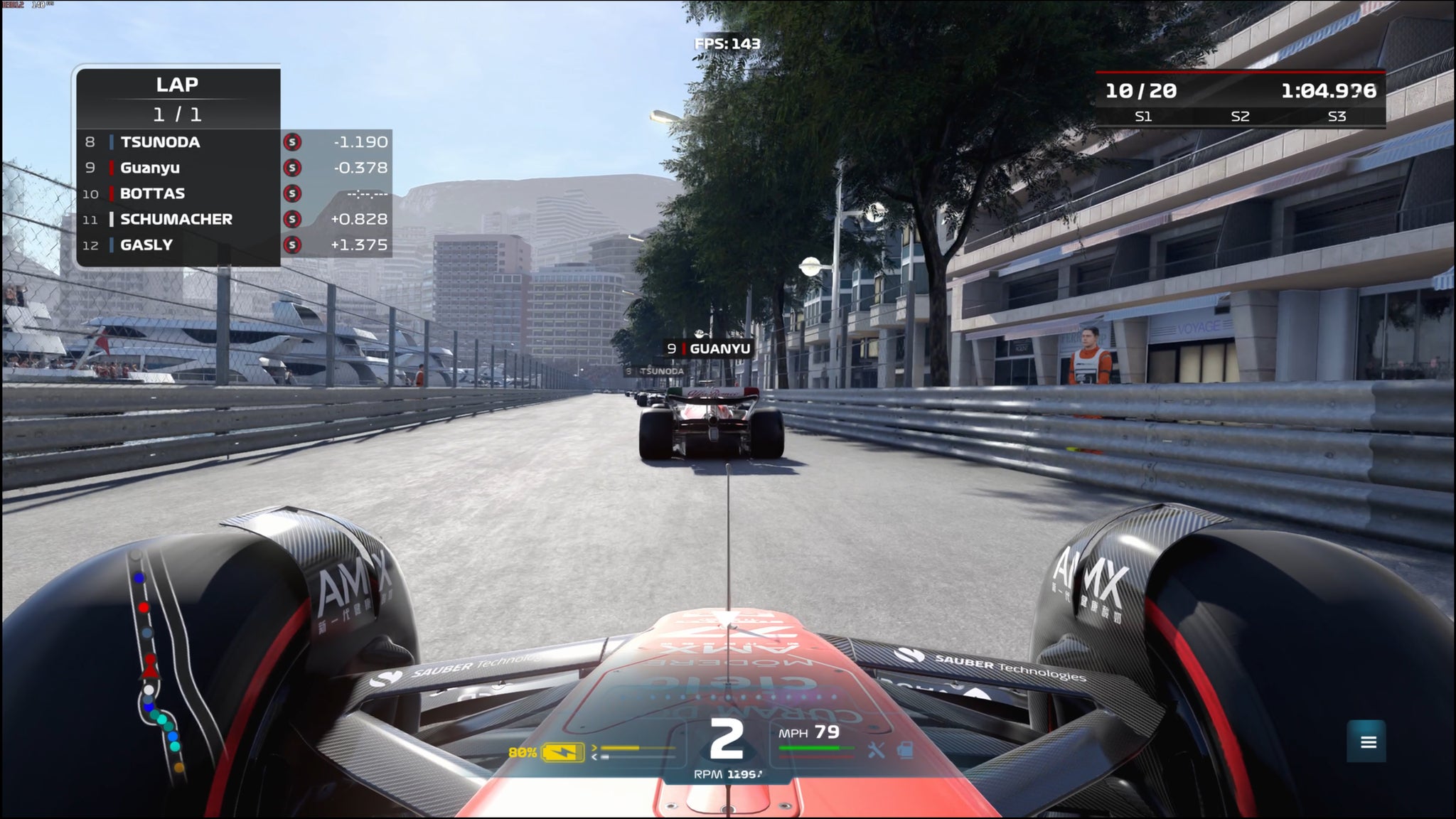
3840x2160, Ultra High quality, DLSS 3 Quality (generated frame)
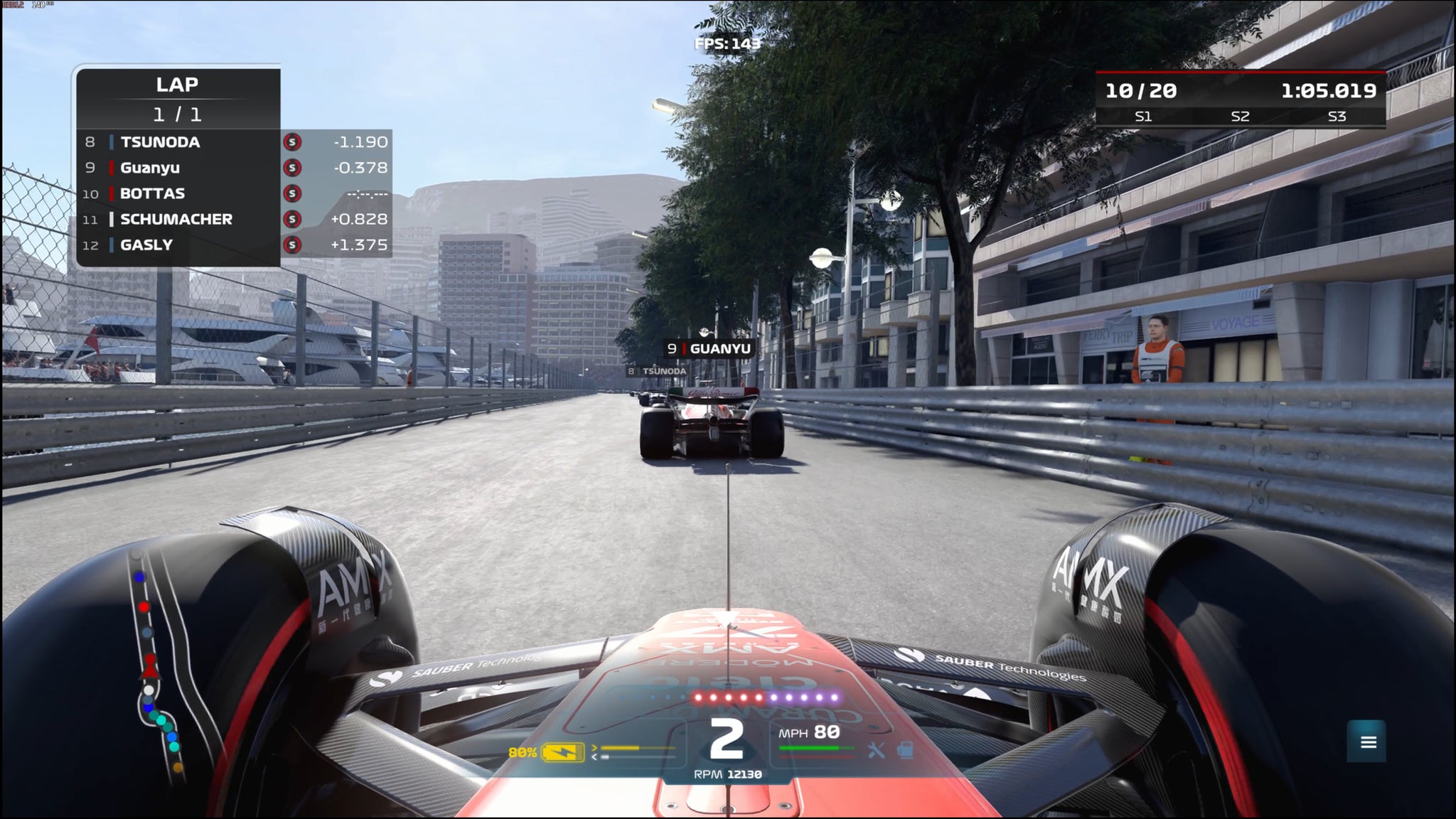
3840x2160, Ultra High quality, DLSS 3 Quality (rendered frame)
Textures look identical, details look identical, AA looks identical… the only noticeable difference is a slightly messed up piece of UI, the lap clock up in the top-right. And it’s such a small detail, appearing for such a short amount of time - less than a hundredth of a second – that it’s impossible to spot when the game is in motion. Here are the two frames zoomed in, showing how well the generated frames can match the detailing of rendered frames:
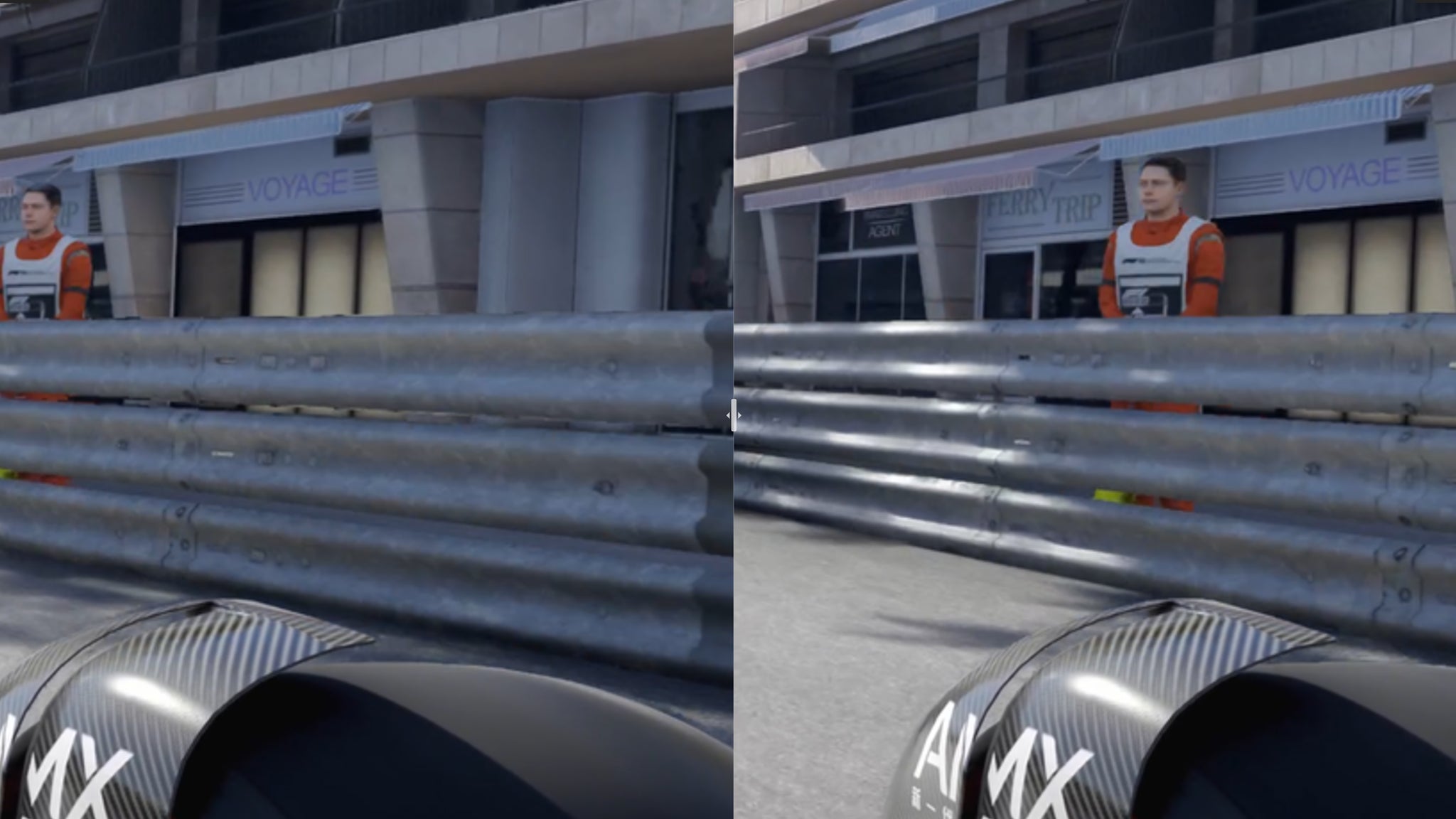
Left: generated frame. Right: rendered frame
This was typical of both Microsoft Flight Simulator and Cyberpunk 2077, as well. Here’s a generated frame of Flight Sim…
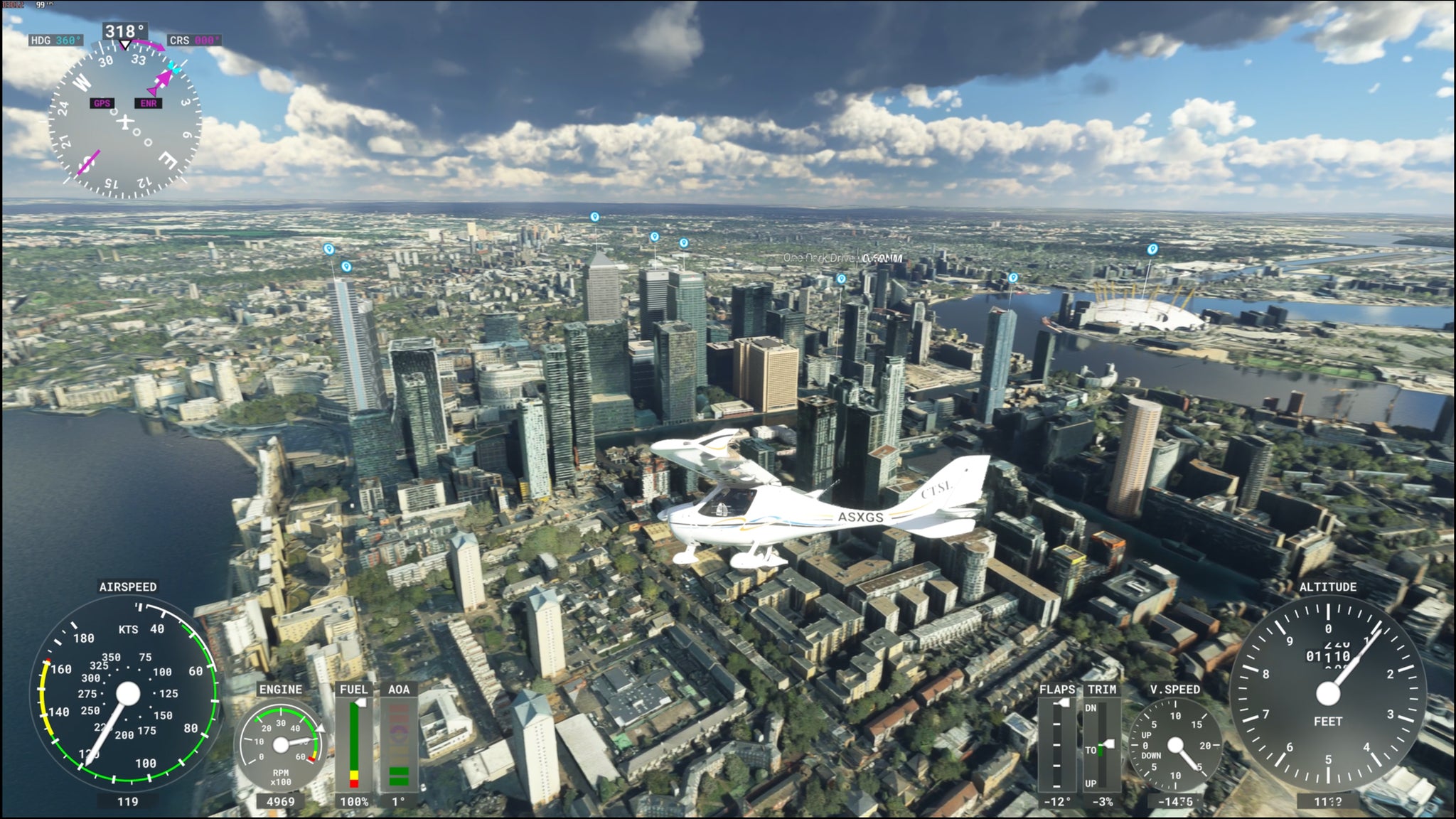
3840x2160, Ultra quality, DLSS 3 Quality (generated frame)
…and a rendered frame:
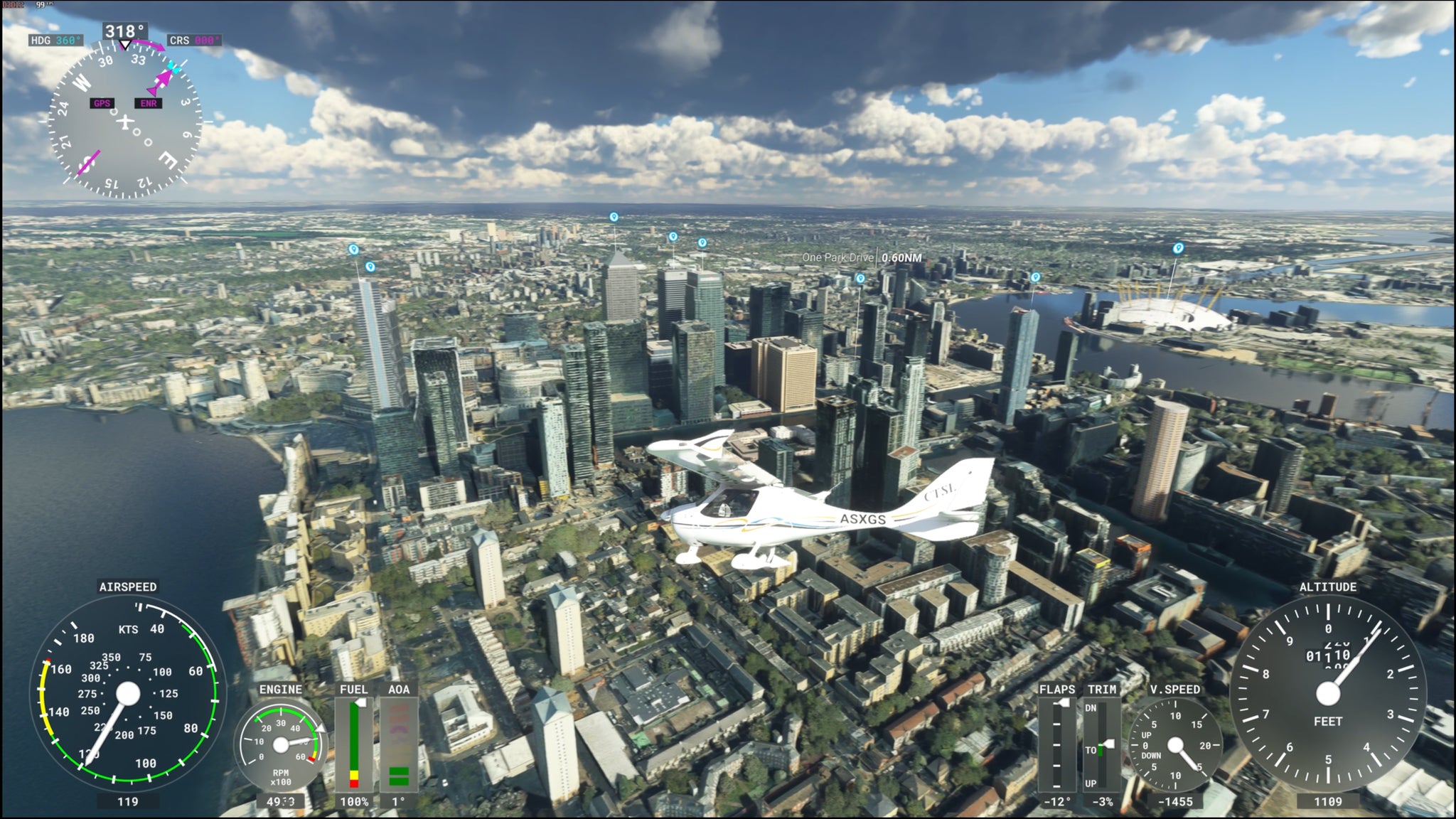
3840x2160, Ultra quality, DLSS 3 Quality (rendered frame)
Again, no differences or downgrades worth mentioning except for a dash of scrambled UI that’s invisible in motion. Missed it the first time? Here it is zoomed in:

Left: generated frame. Right: rendered frame
And lastly, the same deal in Cyberpunk 2077. The generated frame has a slightly messy bit of UI, this time on the mission log…
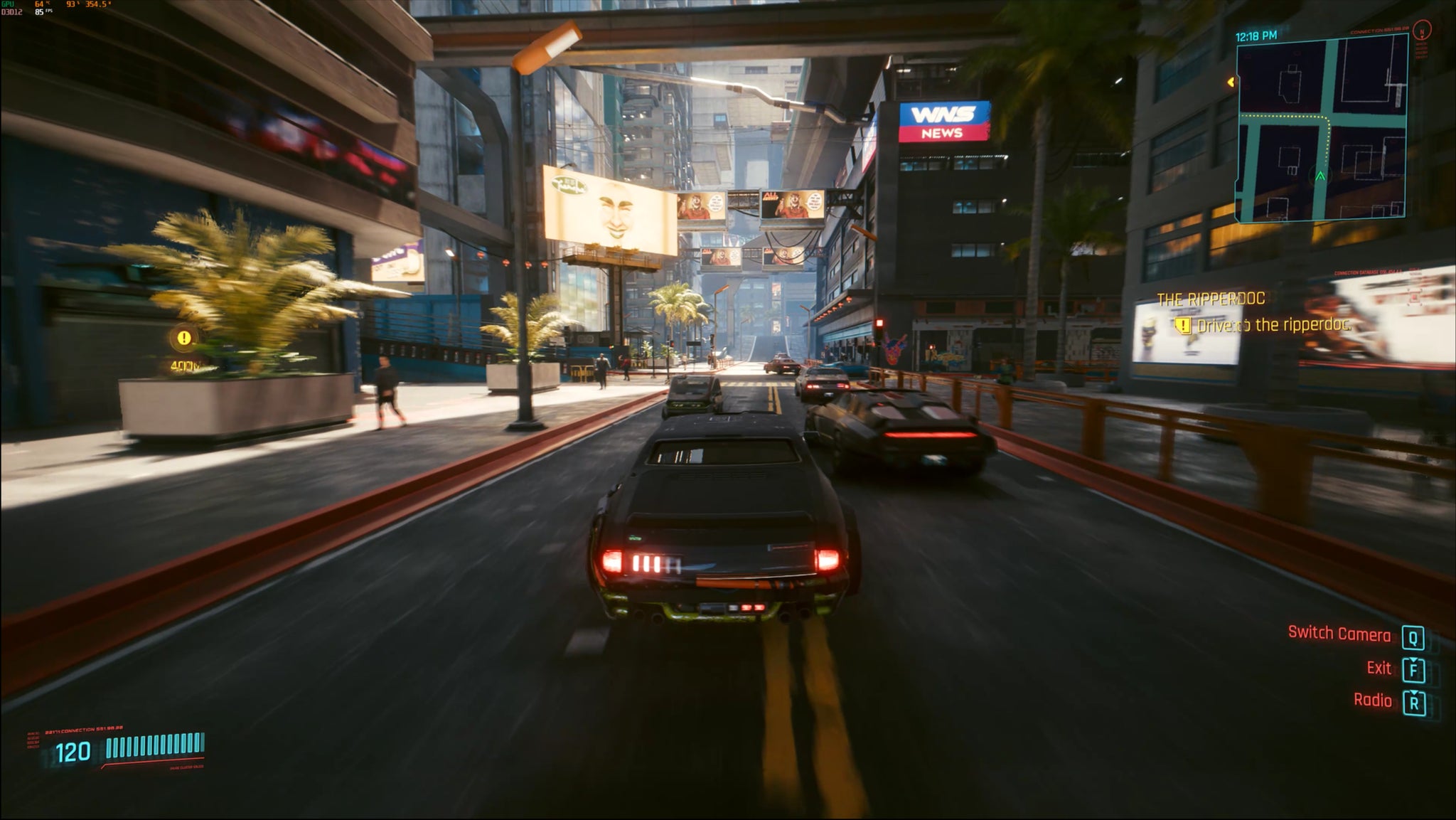
3840x2160, High quality, Psycho RT, DLSS 3 Quality (generated frame)
…but is otherwise indistinguishable from a subsequent rendered frame:
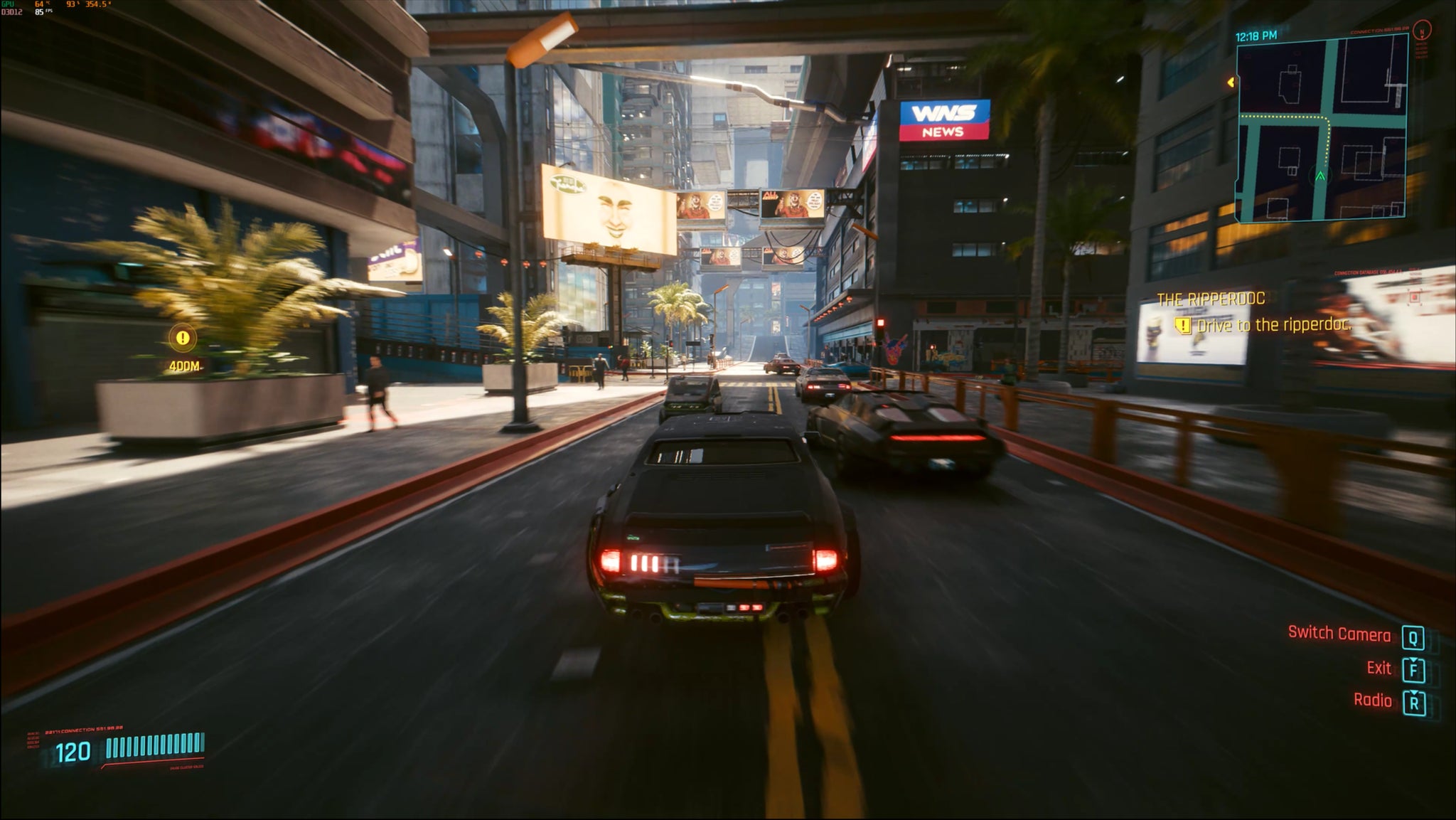
3840x2160, High quality, Psycho RT, DLSS 3 Quality (rendered frame)
Zooming in closely, there’s also a teensy bit of artifacting around the road barrier in the generated frame, but what is noticeable in a blown-up screenshot isn’t always visible when playing the game normally. And I honestly didn’t notice this, nor the UI issue, when playing.
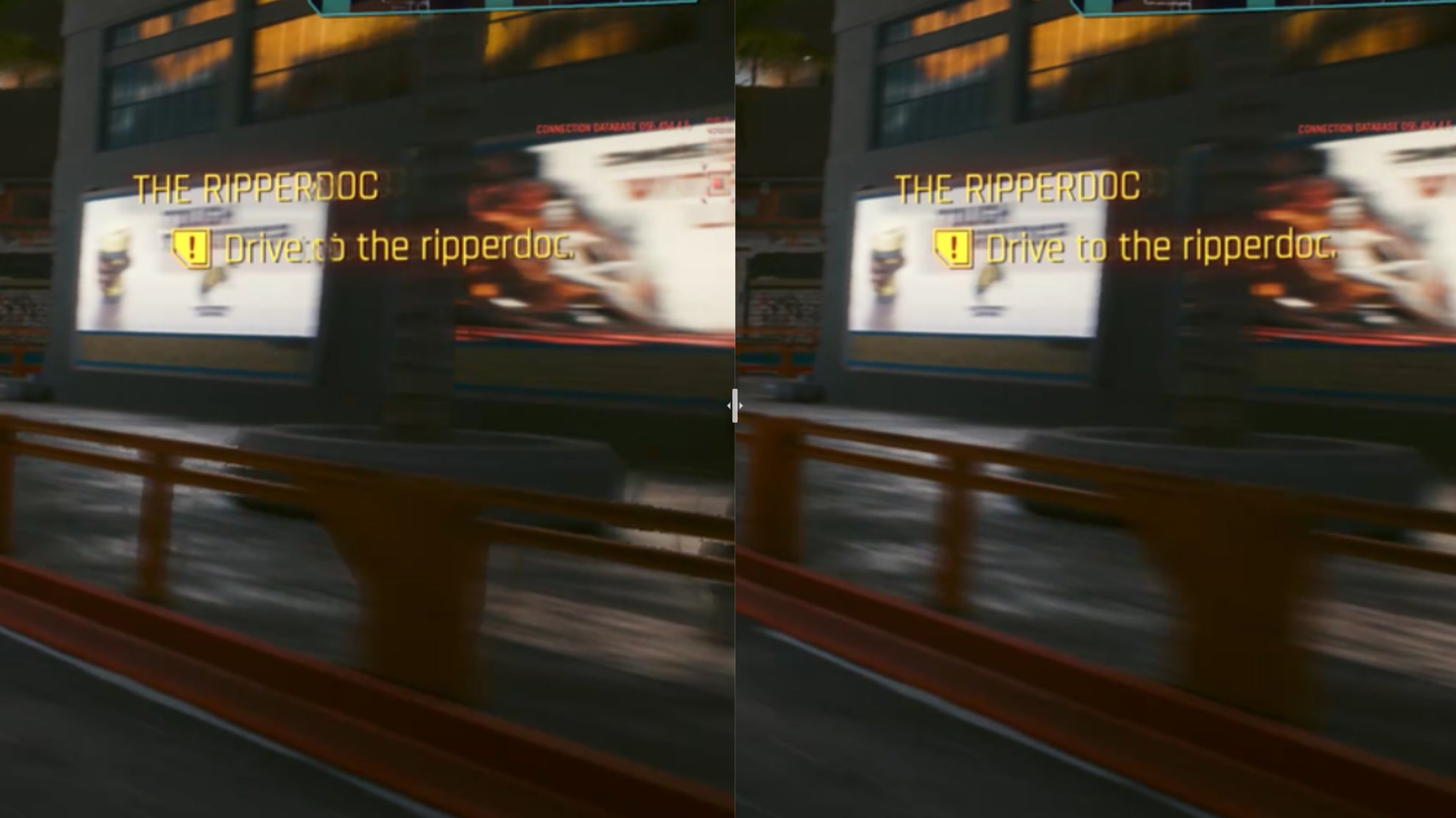
Left: generated frame. Right: rendered frame
Obviously the ideal would be to have generated frames be absolutely pixel perfect, but they really don’t need to be in practice. Instead, they come close enough that these small hiccups become impossible to spot with the naked eye. Unless you were to record them, capture individual frames as PNGs, then upload them to the PC gaming site you work for.
There is one situation in which the AI generation gets confused, which is when sudden changes in scene or perspective make it harder for DLSS 3 to produce an image consistent with previous frames. In both F1 and Cyberpunk 2077, for example, you can quickly switch the driving camera position; if it’s DLSS 3’s turn to generate a frame right as the switch occurs, it will be drawing much OF the visual data it requires from a perspective that’s no longer in use. Hence, frames like this:
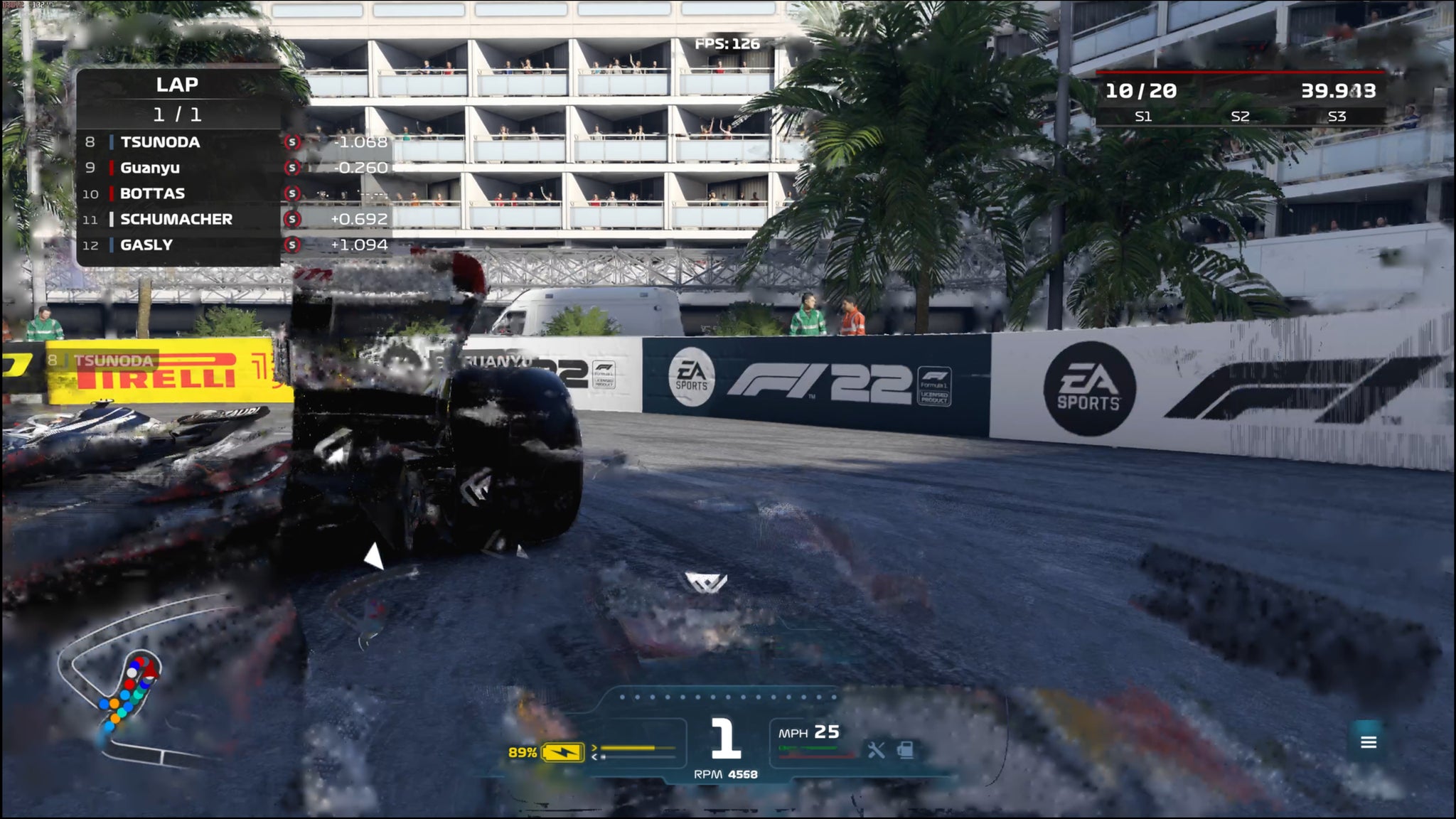
3840x2160, Ultra High quality, DLSS 3 Quality (generated frame)
Or this:
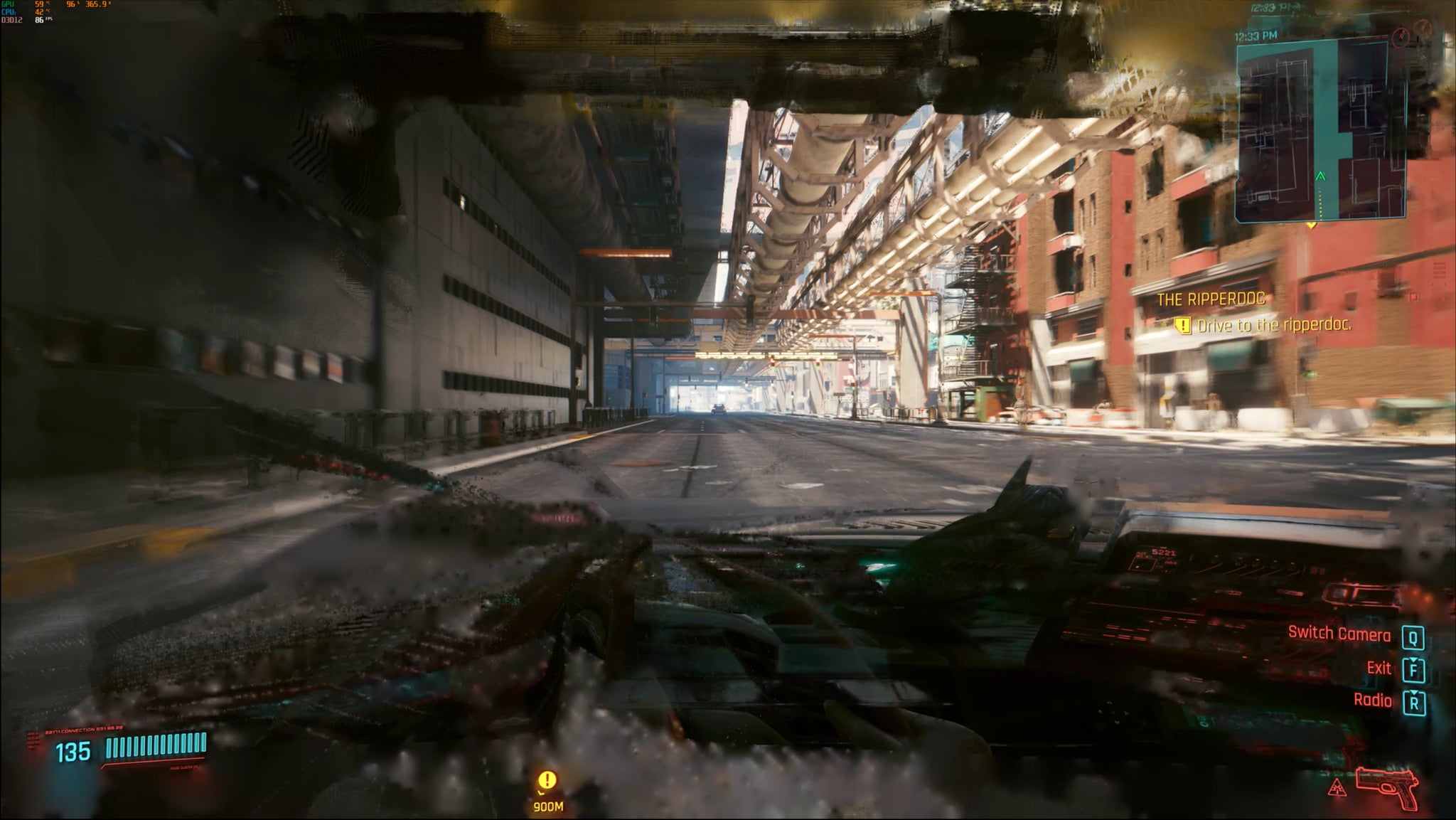
3840x2160, High quality, Psycho RT, DLSS 3 Quality (generated frame)
It’s particularly clear in the F1 22 frame that DLSS 3, bless its cotton socks, is trying to estimate an image using two completely different perspectives for source data. But again, in motion these errors are more or less invisible, because they’re onscreen for such little time before being replaced by a totally accurate, traditionally rendered frame. With, of course, subsequent generated frames correcting themselves thanks to having more image data from after the camera angle shift.
I went actively searching for these kinds of errors in both games, rapidly swapping perspectives to try and catch a dodgy frame, but even while staring holes into my monitor I couldn’t pick them out. They’re gone before you can notice them, or at the very least, they blend well enough into the surrounding frames as to become imperceptible.
My only concern is that if there are ever any mid-range/lower-end RTX graphics cards with DLSS 3 support, such blemishes will become more visible, as the lower framerates will leave each frame – including the iffy ones – onscreen for longer. Still, on the RTX 4090 and almost definitely the RTX 4080, it’s fine. Frame generation errors might make for some hate-click Twitter engagements if you screenshot them, but they’re not actually an issue in practice. By and large, then, DLSS 3 looks great.
DLSS 3: performance
DLSS 3 has itself to thank for smoothing over any one-frame AI mistakes, as the bonus generated frames represent such a enormous burst of overall FPS speed that the RTX 4090 could double or even triple its performance averages at 4K.
As the graph below shows, even the RTX 4090 can’t get a solid 60fps in some games when both a native 4K res and top-quality graphics settings are in play. But with the combined upscaling and frame generation of DLSS 3, it’s up to around 100fps in both Cyberpunk 2077 and Microsoft Flight Simulator, with nearly a 100% improvement in F1 2022 as well. And that’s all on the highest Quality setting for DLSS 3; the faster, only slightly less sharp Performance mode could go even further, more than tripling Cyberpunk 2077’s performance compared to native.

Not sure what happened with Performance mode in Flight Sim, mind – that might be an issue with the early build I was testing with. Otherwise, DLSS 3 is clearly capable of FPS gains that would be impossible through upscaling alone, short of applying a quality-wrecking drop in render resolution. This lets you keep all the crispness of native 4K without the performance hit.
Outside of the fact that it’s limited to a small number of fiercely costly GPUs, that might make DLSS 3 seem like the inarguable gold standard of PC performance sorcery; the default setting that any RTX 40something owners should enable immediately, in all currently supporting games and any that might arrive in the future. Alas, it’s not quite that simple.
The reasons why have nothing to do with easily-missed frame generation errors like the ones above. Instead, it’s mainly a matter of that nebulously definable (but very real) concept in games: feel.
Raising performance, be it through buying hardware upgrades, lowering graphics settings, or employing tricks like upscaling, isn’t usually just to make games look nicer – a lot of games feel better when running at a higher FPS. Aiming becomes sharper. Steering becomes more responsive. MOBA teamfights become less of an unreadable clusterfudge. DLSS 3 can serve this noble goal through its upscaling component, but those AI-generated frames? They’re purely a visual aid, and you’re not going to feel those at all.
Here’s an example from my testing. Cyberpunk 2077, running on max settings with Psycho ray tracing switched on, could run at about 100fps with Ultra-quality DLSS 3 and frame generation. Great! Looks lovely. But I definitely got the sense that weapon aiming and driving camera movements weren’t as sharp and immediate as I’d expect from 100fps – it all felt fine, and perfectly playable, but maybe more along the lines of a 60fps game than a 100fps one. Sure enough, I switched off frame generation (keeping Quality upscaling on), measured performance again, and what was it averaging? About 60fps. As far as the rest of my PC knew, that was what Cyberpunk 2077 was running at, so that’s the level of input responsiveness I got. And why would it know better? Those frames are fakes, separate from the assembly line of actual rendered frames.
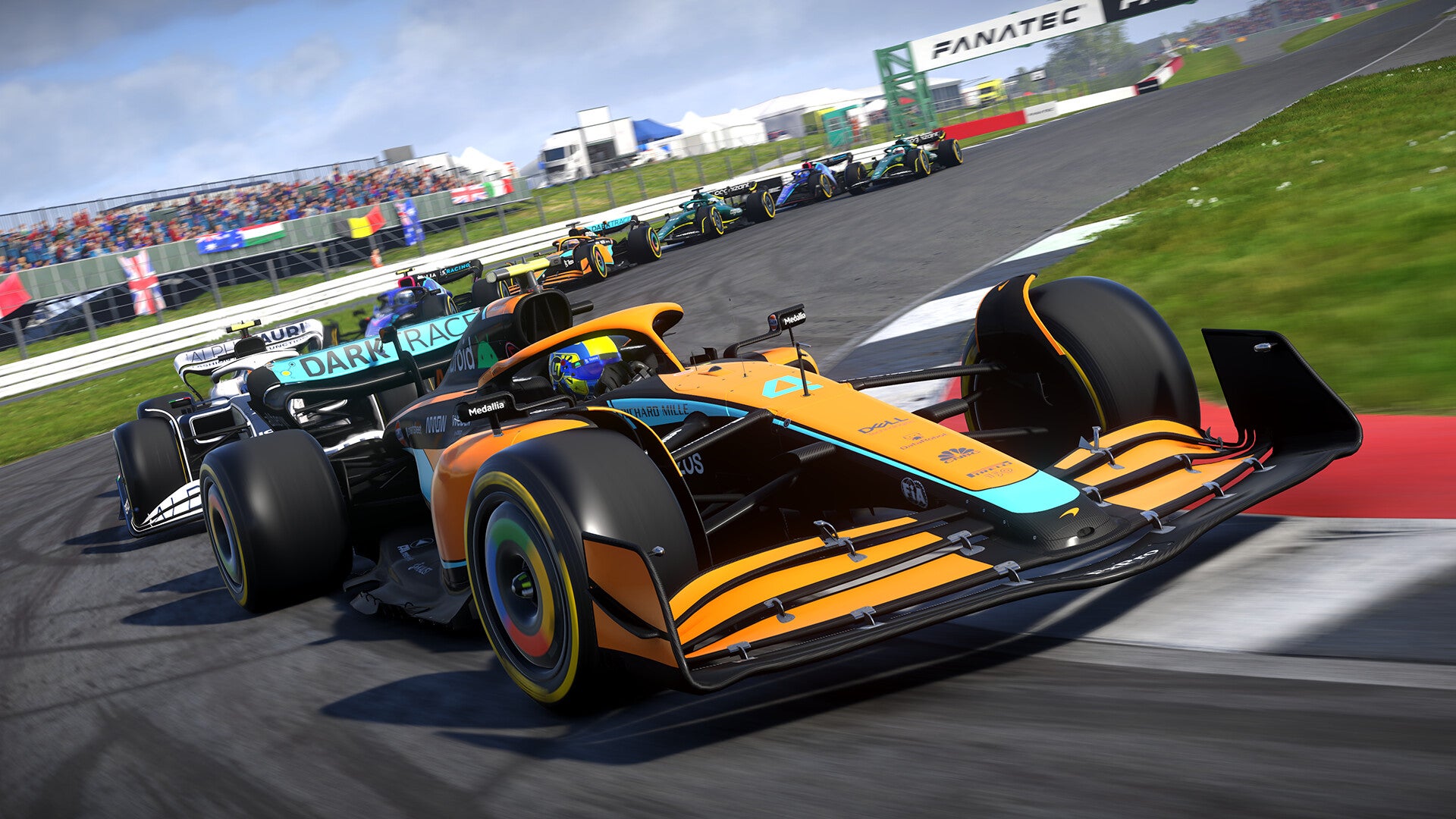
Another potential issue is input lag. DLSS 2 introduces a teensy bit of this when it’s turned on, but DLSS 3 with frame generation adds more. Smartly, Nvidia have decreed that any game with DLSS 3 must also support Nvidia Reflex , their GPU-based, latency-cutting tech; with this running in tandem, lag is ultimately kept low enough that I could happily play Cyberpunk 2077 or Flight Sim without adverse sluggishness. Still, neither of those are particularly twitchy, and knowingly turning up latency is a big ask for more competitive games.
Then again, this might be a worry that never comes to pass. The kinds of games where cutting a sliver of latency might actually make a tangible difference – mainly sweaty shooters like CS:GO or Valorant – are not currently represented among the confirmed DLSS 3 roster, and even if they were, they’re using built to run at fast framerates on older and low-end hardware. They’re not, in other words, likely to need DLSS in the first place – not for its upscaling and certainly not for its frame generation.
DLSS 3: should you use it?
I can understand approaching DLSS 3 with more caution than the average upscaler; it’s certainly wrapped in a thicker layer of caveats than DLSS 2, which is often a no-brainer for any PC with a compatible card.

Besides DLSS 3’s own narrow hardware requirements, there’s also the matter of needing a sufficiently high-specced monitor to take full advantage of it. A 4K gaming monitor with an above-100Hz refresh rate is best, but those are mighty expensive, and although 1440p monitors will benefit, that resolution doesn’t put nearly the same strain on games as 4K. Thus, frame generation becomes less useful.
Despite all that, I’m staying pretty positive about DLSS 3, and do think that you should give it a whirl if you find yourself in possession of a compatible GPU and a suitable display.
The performance gains it affords at tough resolutions are almost unbelievable – and yes, they might be comprised of fake frames, but remember that there’s still upscaling going on in the background. That will improve the feel of your games, at least compared to trying to run them at native res. And even if they don’t help responsiveness, is there really a compelling reason to give up the extra visual enhancement of these frames? I’d say nah, not when the latency impact remains minor with Reflex, and when those occasional AI generation errors are functionally invisible.
For best results, try to secure a good level of performance - say, 60fps - with upscaling on but frame generation turned off. This will mean that if you choose to add those additional frames, the visual benefit they provide will sit on top of a solid baseline for control smoothness.

Cyberpunk 2077
PS4 , PS5 , Xbox One , Xbox Series X/S , PC

F1 22
PS4 , PS5 , Xbox One , Xbox Series X/S , PC

Microsoft Flight Simulator
Video Game
Rock Paper Shotgun is better when you sign in
Sign in and join us on our journey to discover strange and compelling PC games.

All 75 Arc Raiders Blueprints and where to get them
These areas have the highest chance of giving you Blueprints
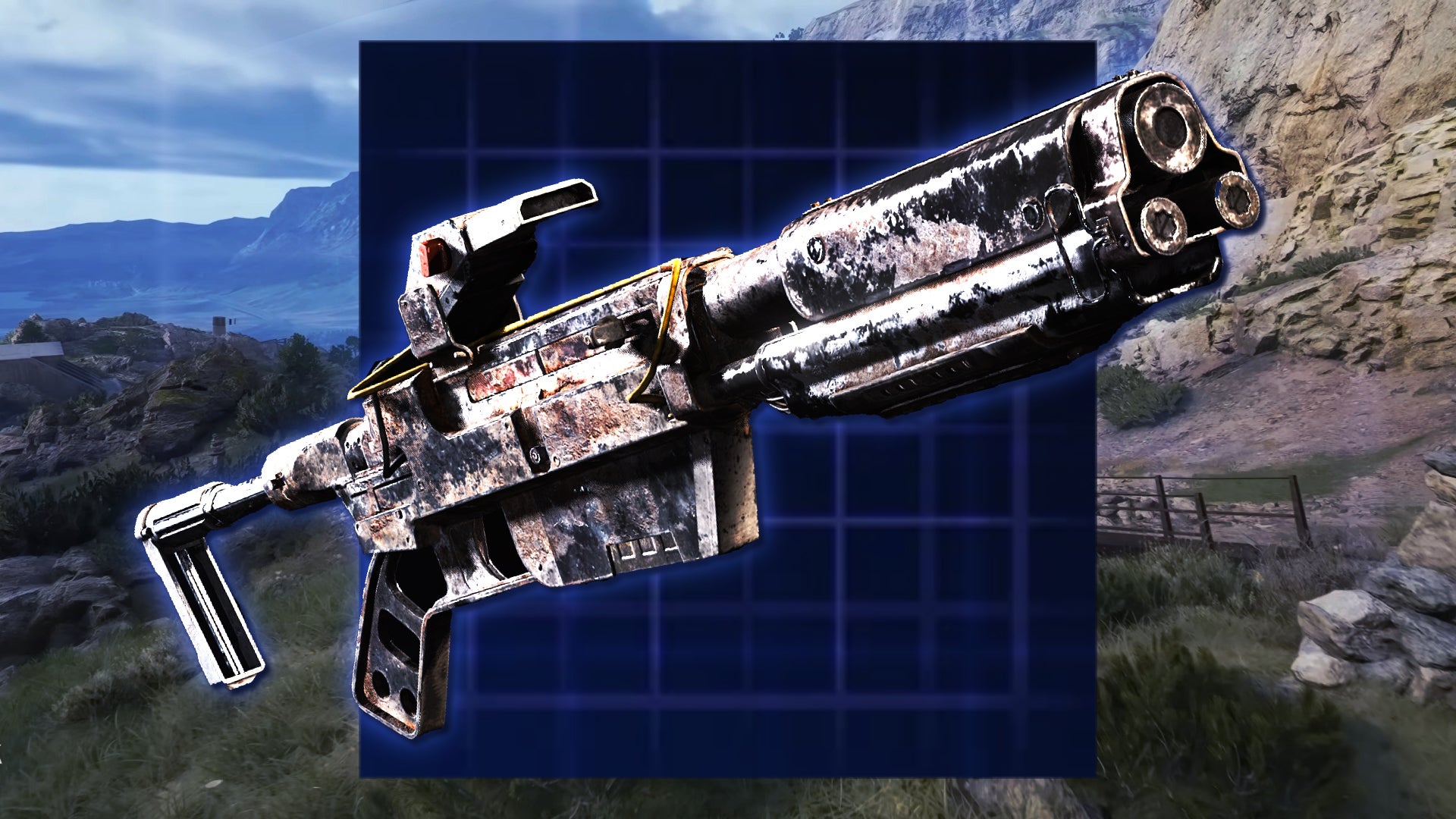
Image credit:Rock Paper Shotgun/Embark Studios

Looking for more Arc Raiders Blueprints? It’s a special day when you find a Blueprint, as they’re among the most valuable items in Arc Raiders. If you find a Blueprint that you haven’t already found, then you must make sure you hold onto it at all costs, because Blueprints are the key to one of the most important and powerful systems of meta-progression in the game.
This guide aims to be the very best guide on Blueprints you can find, starting with a primer on what exactly they are and how they work in Arc Raiders, before delving into exactly where to get Blueprints and the very best farming spots for you to take in your search.
We’ll also go over how to get Blueprints from other unlikely activities, such as destroying Surveyors and completing specific quests. And you’ll also find the full list of all 75 Blueprints in Arc Raiders on this page (including the newest Blueprints added with the Cold Snap update , such as the Deadline Blueprint and Firework Box Blueprint), giving you all the information you need to expand your own crafting repertoire.
In this guide:
- What are Blueprints in Arc Raiders?
- Full Blueprint list: All crafting recipes
- Where to find Blueprints in Arc Raiders Blueprints obtained from quests Blueprints obtained from Trials Best Blueprint farming locations

What are Blueprints in Arc Raiders?
Blueprints in Arc Raiders are special items which, if you manage to extract with them, you can expend to permanently unlock a new crafting recipe in your Workshop. If you manage to extract from a raid with an Anvil Blueprint, for example, you can unlock the ability to craft your very own Anvil Pistol, as many times as you like (as long as you have the crafting materials).
To use a Blueprint, simply open your Inventory while in the lobby, then right-click on the Blueprint and click “Learn And Consume” . This will permanently unlock the recipe for that item in your Workshop. As of the Stella Montis update, there are allegedly 75 different Blueprints to unlock - although only 68 are confirmed to be in the game so far. You can see all the Blueprints you’ve found and unlocked by going to the Workshop menu, and hitting “R” to bring up the Blueprint screen.
It’s possible to find duplicates of past Blueprints you’ve already unlocked. If you find these, then you can either sell them, or - if you like to play with friends - you can take it into a match and gift it to your friend so they can unlock that recipe for themselves. Another option is to keep hold of them until the time comes to donate them to the Expedition.
Full Blueprint list: All crafting recipes
Below is the full list of all the Blueprints that are currently available to find in Arc Raiders, and the crafting recipe required for each item:
| Blueprint | Type | Recipe | Crafted At |
|---|---|---|---|
| Bettina | Weapon | 3x Advanced Mechanical Components 3x Heavy Gun Parts 3x Canister | Gunsmith 3 |
| Blue Light Stick | Quick Use | 3x Chemicals | Utility Station 1 |
| Aphelion | Weapon | 3x Magnetic Accelerator 3x Complex Gun Parts 1x Matriarch Reactor | Gunsmith 3 |
| Combat Mk. 3 (Flanking) | Augment | 2x Advanced Electrical Components 3x Processor | Gear Bench 3 |
| Combat Mk. 3 (Aggressive) | Augment | 2x Advanced Electrical Components 3x Processor | Gear Bench 3 |
| Complex Gun Parts | Material | 2x Light Gun Parts 2x Medium Gun Parts 2x Heavy Gun Parts | Refiner 3 |
| Fireworks Box | Quick Use | 1x Explosive Compound 3x Pop Trigger | Explosives Station 2 |
| Gas Mine | Mine | 4x Chemicals 2x Rubber Parts | Explosives Station 1 |
| Green Light Stick | Quick Use | 3x Chemicals | Utility Station 1 |
| Pulse Mine | Mine | 1x Crude Explosives 1x Wires | Explosives Station 1 |
| Seeker Grenade | Grenade | 1x Crude Explosives 2x ARC Alloy | Explosives Station 1 |
| Looting Mk. 3 (Survivor) | Augment | 2x Advanced Electrical Components 3x Processor | Gear Bench 3 |
| Angled Grip II | Mod | 2x Mechanical Components 3x Duct Tape | Gunsmith 2 |
| Angled Grip III | Mod | 2x Mod Components 5x Duct Tape | Gunsmith 3 |
| Hullcracker | Weapon | 1x Magnetic Accelerator 3x Heavy Gun Parts 1x Exodus Modules | Gunsmith 3 |
| Launcher Ammo | Ammo | 5x Metal Parts 1x Crude Explosives | Workbench 1 |
| Anvil | Weapon | 5x Mechanical Components 5x Simple Gun Parts | Gunsmith 2 |
| Anvil Splitter | Mod | 2x Mod Components 3x Processor | Gunsmith 3 |
| ??? | ??? | ??? | ??? |
| Barricade Kit | Quick Use | 1x Mechanical Components | Utility Station 2 |
| Blaze Grenade | Grenade | 1x Explosive Compound 2x Oil | Explosives Station 3 |
| Bobcat | Weapon | 3x Advanced Mechanical Components 3x Light Gun Parts | Gunsmith 3 |
| Osprey | Weapon | 2x Advanced Mechanical Components 3x Medium Gun Parts 7x Wires | Gunsmith 3 |
| Burletta | Weapon | 3x Mechanical Components 3x Simple Gun Parts | Gunsmith 1 |
| Compensator II | Mod | 2x Mechanical Components 4x Wires | Gunsmith 2 |
| Compensator III | Mod | 2x Mod Components 8x Wires | Gunsmith 3 |
| Defibrillator | Quick Use | 9x Plastic Parts 1x Moss | Medical Lab 2 |
| ??? | ??? | ??? | ??? |
| Equalizer | Weapon | 3x Magnetic Accelerator 3x Complex Gun Parts 1x Queen Reactor | Gunsmith 3 |
| Extended Barrel | Mod | 2x Mod Components 8x Wires | Gunsmith 3 |
| Extended Light Mag II | Mod | 2x Mechanical Components 3x Steel Spring | Gunsmith 2 |
| Extended Light Mag III | Mod | 2x Mod Components 5x Steel Spring | Gunsmith 3 |
| Extended Medium Mag II | Mod | 2x Mechanical Components 3x Steel Spring | Gunsmith 2 |
| Extended Medium Mag III | Mod | 2x Mod Components 5x Steel Spring | Gunsmith 3 |
| Extended Shotgun Mag II | Mod | 2x Mechanical Components 3x Steel Spring | Gunsmith 2 |
| Extended Shotgun Mag III | Mod | 2x Mod Components 5x Steel Spring | Gunsmith 3 |
| Remote Raider Flare | Quick Use | 2x Chemicals 4x Rubber Parts | Utility Station 1 |
| Heavy Gun Parts | Material | 4x Simple Gun Parts | Refiner 2 |
| Venator | Weapon | 2x Advanced Mechanical Components 3x Medium Gun Parts 5x Magnet | Gunsmith 3 |
| Il Toro | Weapon | 5x Mechanical Components 6x Simple Gun Parts | Gunsmith 1 |
| Jolt Mine | Mine | 1x Electrical Components 1x Battery | Explosives Station 2 |
| Explosive Mine | Mine | 1x Explosive Compound 1x Sensors | Explosives Station 3 |
| Jupiter | Weapon | 3x Magnetic Accelerator 3x Complex Gun Parts 1x Queen Reactor | Gunsmith 3 |
| Light Gun Parts | Material | 4x Simple Gun Parts | Refiner 2 |
| Lightweight Stock | Mod | 2x Mod Components 5x Duct Tape | Gunsmith 3 |
| Lure Grenade | Grenade | 1x Speaker Component 1x Electrical Components | Utility Station 2 |
| Medium Gun Parts | Material | 4x Simple Gun Parts | Refiner 2 |
| Torrente | Weapon | 2x Advanced Mechanical Components 3x Medium Gun Parts 6x Steel Spring | Gunsmith 3 |
| Muzzle Brake II | Mod | 2x Mechanical Components 4x Wires | Gunsmith 2 |
| Muzzle Brake III | Mod | 2x Mod Components 8x Wires | Gunsmith 3 |
| Padded Stock | Mod | 2x Mod Components 5x Duct Tape | Gunsmith 3 |
| Shotgun Choke II | Mod | 2x Mechanical Components 4x Wires | Gunsmith 2 |
| Shotgun Choke III | Mod | 2x Mod Components 8x Wires | Gunsmith 3 |
| Shotgun Silencer | Mod | 2x Mod Components 8x Wires | Gunsmith 3 |
| Showstopper | Grenade | 1x Advanced Electrical Components 1x Voltage Converter | Explosives Station 3 |
| Silencer I | Mod | 2x Mechanical Components 4x Wires | Gunsmith 2 |
| Silencer II | Mod | 2x Mod Components 8x Wires | Gunsmith 3 |
| Snap Hook | Quick Use | 2x Power Rod 3x Rope 1x Exodus Modules | Utility Station 3 |
| Stable Stock II | Mod | 2x Mechanical Components 3x Duct Tape | Gunsmith 2 |
| Stable Stock III | Mod | 2x Mod Components 5x Duct Tape | Gunsmith 3 |
| Tagging Grenade | Grenade | 1x Electrical Components 1x Sensors | Utility Station 3 |
| Tempest | Weapon | 3x Advanced Mechanical Components 3x Medium Gun Parts 3x Canister | Gunsmith 3 |
| Trigger Nade | Grenade | 2x Crude Explosives 1x Processor | Explosives Station 2 |
| Vertical Grip II | Mod | 2x Mechanical Components 3x Duct Tape | Gunsmith 2 |
| Vertical Grip III | Mod | 2x Mod Components 5x Duct Tape | Gunsmith 3 |
| Vita Shot | Quick Use | 2x Antiseptic 1x Syringe | Medical Lab 3 |
| Vita Spray | Quick Use | 3x Antiseptic 1x Canister | Medical Lab 3 |
| Vulcano | Weapon | 1x Magnetic Accelerator 3x Heavy Gun Parts 1x Exodus Modules | Gunsmith 3 |
| Wolfpack | Grenade | 2x Explosive Compound 2x Sensors | Explosives Station 3 |
| Red Light Stick | Quick Use | 3x Chemicals | Utility Station 1 |
| Smoke Grenade | Grenade | 14x Chemicals 1x Canister | Utility Station 2 |
| Deadline | Mine | 3x Explosive Compound 2x ARC Circuitry | Explosives Station 3 |
| Trailblazer | Grenade | 1x Explosive Compound 1x Synthesized Fuel | Explosives Station 3 |
| Tactical Mk. 3 (Defensive) | Augment | 2x Advanced Electrical Components 3x Processor | Gear Bench 3 |
| Tactical Mk. 3 (Healing) | Augment | 2x Advanced Electrical Components 3x Processor | Gear Bench 3 |
| Yellow Light Stick | Quick Use | 3x Chemicals | Utility Station 1 |
Note: The missing Blueprints in this list likely have not actually been added to the game at the time of writing, because none of the playerbase has managed to find any of them. As they are added to the game, I will update this page with the most relevant information so you know exactly how to get all 75 Arc Raiders Blueprints.
Where to find Blueprints in Arc Raiders
Below is a list of all containers, modifiers, and events which maximise your chances of finding Blueprints:
- Certain quests reward you with specific Blueprints .
- Completing Trials has a high chance of offering Blueprints as rewards.
- Surveyors have a decent chance of dropping Blueprints on death.
- High loot value areas tend to have a greater chance of spawning Blueprints.
- Night Raids and Storms may increase rare Blueprint spawn chances in containers.
- Containers with higher numbers of items may have a higher tendency to spawn Blueprints. As a result, Blue Gate (which has many “large” containers containing multiple items) may give you a higher chance of spawning Blueprints.
- Raider containers (Raider Caches, Weapon Boxes, Medical Bags, Grenade Tubes) have increased Blueprint drop rates. As a result, the Uncovered Caches event gives you a high chance of finding Blueprints.
- Security Lockers have a higher than average chance of containing Blueprints.
- Certain Blueprints only seem to spawn under specific circumstances: Tempest Blueprint only spawns during Night Raid events. Vulcano Blueprint only spawns during Hidden Bunker events. Jupiter and Equaliser Blueprints only spawn during Harvester events.
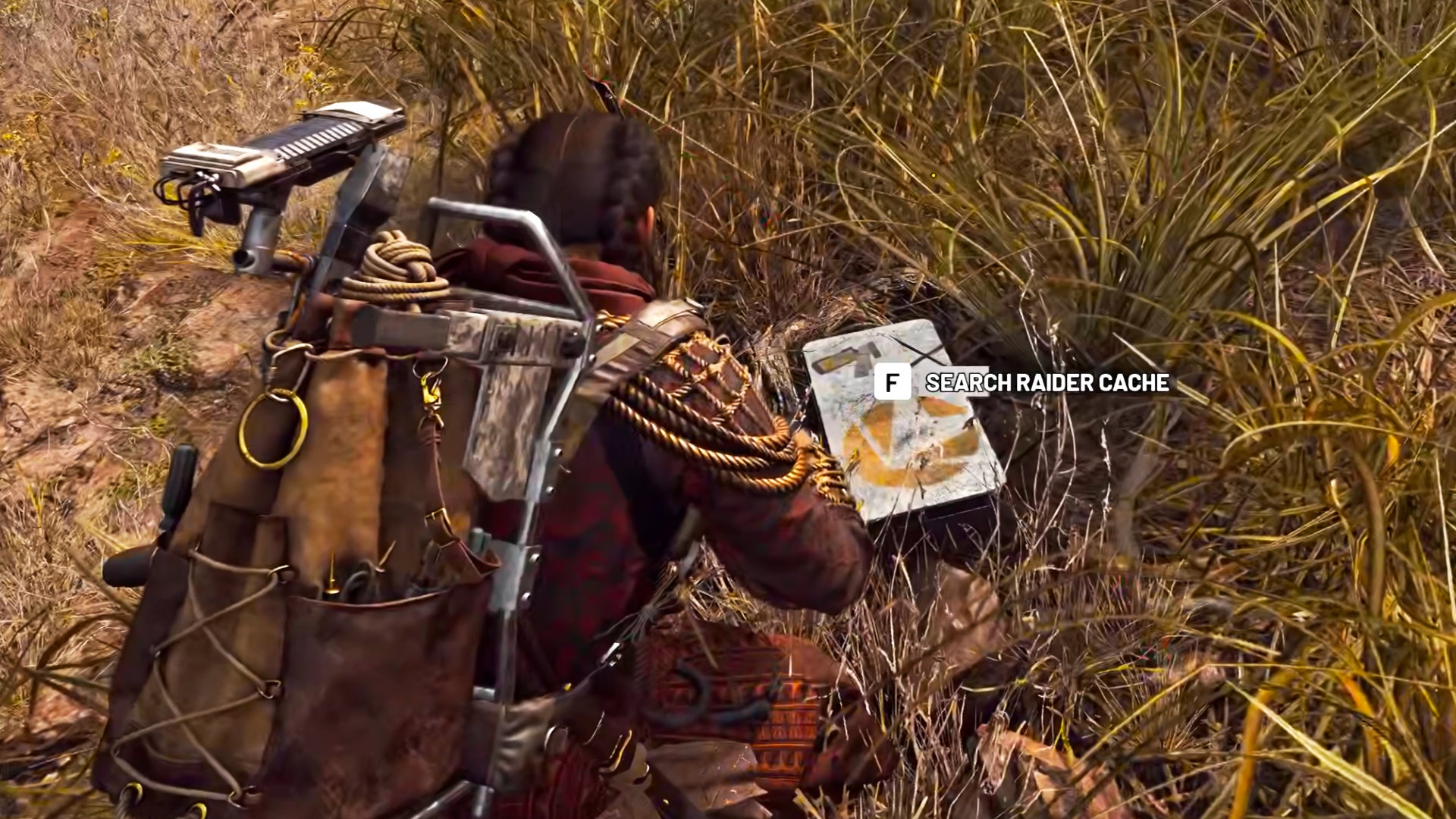
Raider Caches, Weapon Boxes, and other raider-oriented container types have a good chance of offering Blueprints. |Image credit:Rock Paper Shotgun/Embark Studios
Blueprints have a very low chance of spawning in any container in Arc Raiders, around 1-2% on average. However, there is a higher chance of finding Blueprints in particular container types. Specifically, you can find more Blueprints in Raider containers and security lockers.
Beyond this, if you’re looking for Blueprints you should focus on regions of the map which are marked as having particularly high-value loot. Areas such as the Control Tower in Dam Battlegrounds, the Arrival and Departure Buildings in Spaceport, and Pilgrim’s Peak in Blue Gate all have a better-than-average chance of spawning Blueprints somewhere amongst all their containers. Night Raids and Electromagnetic Storm events also increase the drop chances of certain Blueprints .
In addition to these containers, you can often loot Blueprints from destroyed Surveyors - the largest of the rolling ball ARC. Surveyors are more commonly found on the later maps - Spaceport and Blue Gate - and if one spawns in your match, you’ll likely see it by the blue laser beam that it casts into the sky while “surveying”.
Surveyors are quite well-armoured and will very speedily run away from you once it notices you, but if you can take one down then make sure you loot all its parts for a chance of obtaining certain unusual Blueprints.
Blueprints obtained from quests
One way in which you can get Blueprints is by completing certain quests for the vendors in Speranza. Some quests will reward you with a specific item Blueprint upon completion, so as long as you work through all the quests in Arc Raiders, you are guaranteed those Blueprints.
Here is the full list of all Blueprints you can get from quest rewards:
- Trigger Nade Blueprint: Rewarded after completing “Sparks Fly”.
- Lure Grenade Blueprint: Rewarded after completing “Greasing Her Palms”.
- Burletta Blueprint: Rewarded after completing “Industrial Espionage”.
- Hullcracker Blueprint (and Launcher Ammo Blueprint): Rewarded after completing “The Major’s Footlocker”.
Alas, that’s only 4 Blueprints out of a total of 75 to unlock, so for the vast majority you will need to find them yourself during a raid. If you’re intent on farming Blueprints, then it’s best to equip yourself with cheap gear in case you lose it, but don’t use a free loadout because then you won’t get a safe pocket to stash any new Blueprint you find. No pain in Arc Raiders is sharper than failing to extract with a new Blueprint you’ve been after for a dozen hours already.
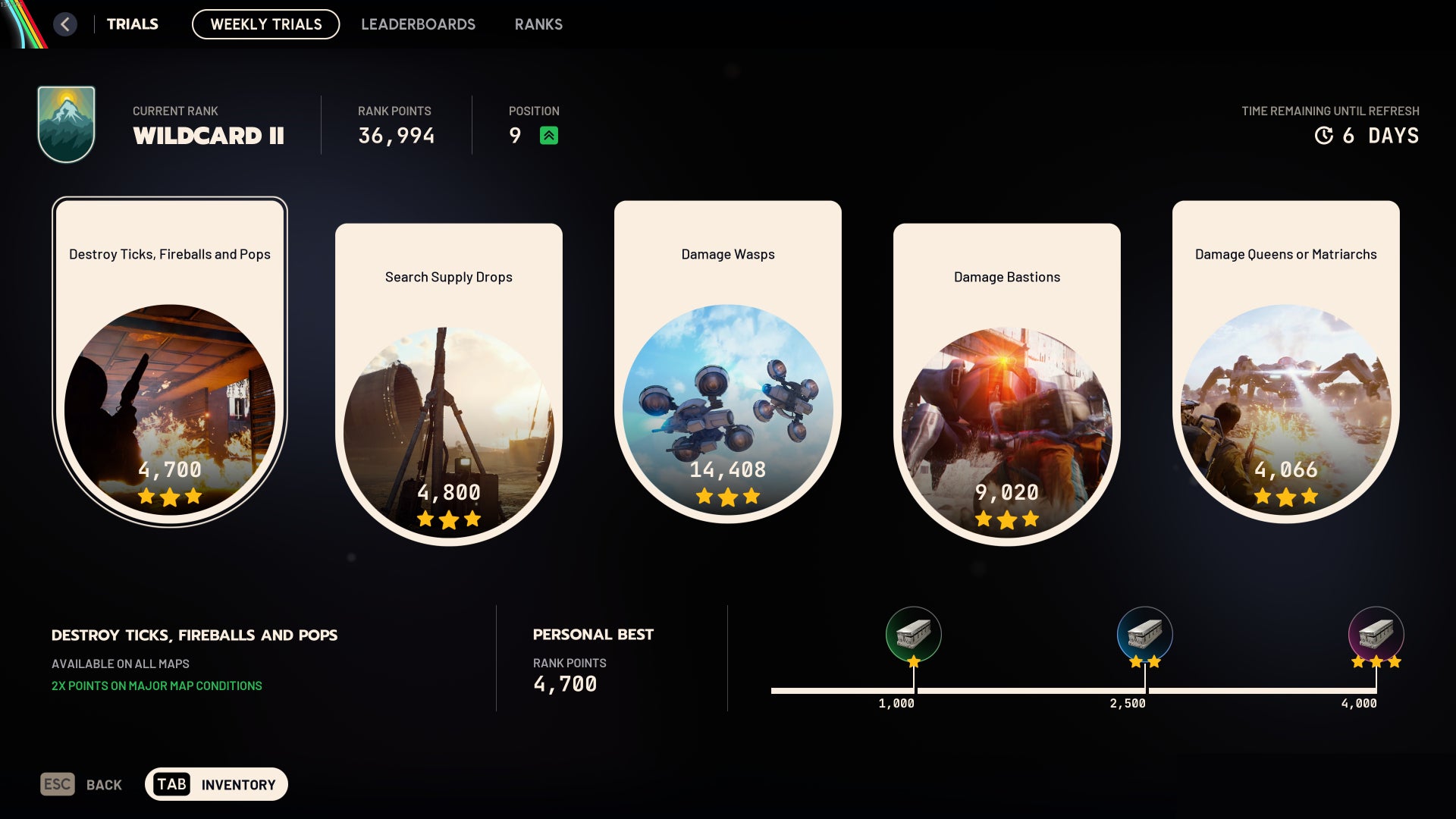
One of the best ways to get Blueprints is by hitting three stars on all five Trials every week. |Image credit:Rock Paper Shotgun/Embark Studios
Blueprints obtained from Trials
One of the very best ways to get Blueprints is as rewards for completing Trials in Arc Raiders. Trials are unlocked from Level 15 onwards, and allow you to earn rewards by focusing on certain tasks over the course of several raids. For example, one Trial might task you with dealing damage to Hornets, while another might challenge you to loot Supply Drops.
Trials refresh on a weekly basis, with a new week bringing five new Trials. Each Trial can offer up to three rewards after passing certain score milestones, and it’s possible to receive very high level loot from these reward crates - including Blueprints. So if you want to unlock as many Blueprints as possible, you should make a point of completing as many Trials as possible each week.
Best Blueprint farming locations
The very best way to get Blueprints is to frequent specific areas of the maps which combine high-tier loot pools with the right types of containers to search. Here are my recommendations for where to find Blueprints on every map, so you can always keep the search going for new crafting recipes to unlock.
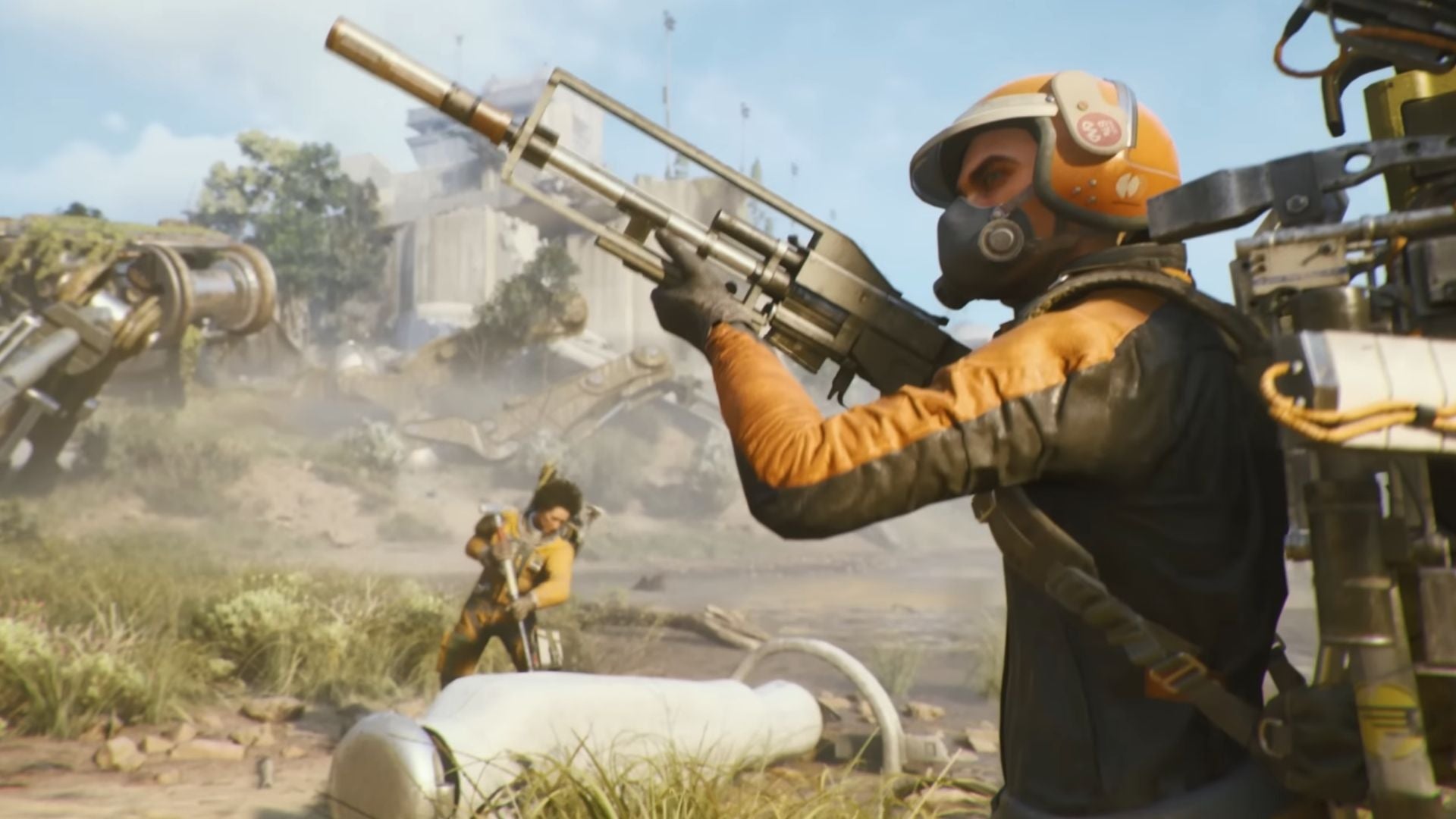
Image credit:Rock Paper Shotgun/Embark Studios
Dam Battlegrounds
The best places to farm Blueprints on Dam Battlegrounds are the Control Tower, Power Generation Complex, Ruby Residence, and Pale Apartments . The first two regions, despite only being marked on the map as mid-tier loot, contain a phenomenal number of containers to loot. The Control Tower can also contain a couple of high-tier Security Lockers - though of course, you’ll need to have unlocked the Security Breach skill at the end of the Survival tree.
There’s also a lot of reporting amongst the playerbase that the Residential areas in the top-left of the map - Pale Apartments and Ruby Residence - give you a comparatively strong chance of finding Blueprints. Considering their size, there’s a high density of containers to loot in both locations, and they also have the benefit of being fairly out of the way. So you’re more likely to have all the containers to yourself.
Buried City
The best Blueprint farming locations on Buried City are the Santa Maria Houses, Grandioso Apartments, Town Hall, and the various buildings of the New District . Grandioso Apartments has a lower number of containers than the rest, but a high chance of spawning weapon cases - which have good Blueprint drop rates. The others are high-tier loot areas, with plenty of lootable containers - including Security Lockers.
Spaceport
The best places to find Blueprints on Spaceport are the Arrival and Departure Buildings, as well as Control Tower A6 and the Launch Towers . All these areas are labelled as high-value loot regions, and many of them are also very handily connected to one another by the Spaceport wall, which you can use to quickly run from one area to the next. At the tops of most of these buildings you’ll find at least one Security Locker, so this is an excellent farming route for players looking to find Blueprints.
The downside to looting Blueprints on Spaceport is that all these areas are hotly contested, particularly in Duos and Squads. You’ll need to be very focused and fast in order to complete the full farming route.
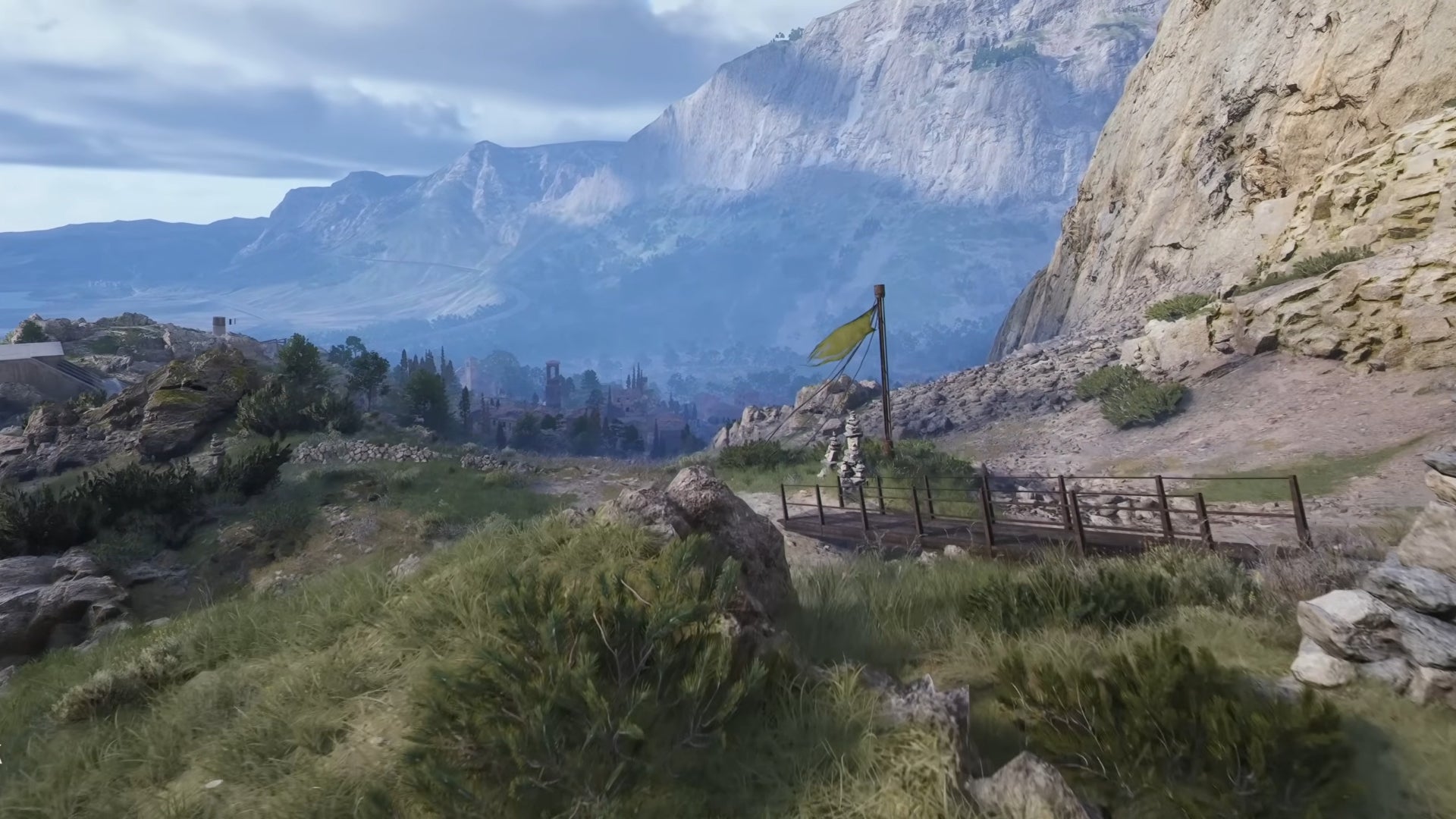
Image credit:Rock Paper Shotgun/Embark Studios
Blue Gate
Blue Gate tends to have a good chance of dropping Blueprints, potentially because it generally has a high number of containers which can hold lots of items; so there’s a higher chance of a Blueprint spawning in each container. In my experience, the best Blueprint farming spots on Blue Gate are Pilgrim’s Peak, Raider’s Refuge, the Ancient Fort, and the Underground Complex beneath the Warehouse .
All of these areas contain a wealth of containers to loot. Raider’s Refuge has less to loot, but the majority of the containers in and around the Refuge are raider containers, which have a high chance of containing Blueprints - particularly during major events.
Stella Montis
On the whole, Stella Montis seems to have a very low drop rate for Blueprints (though a high chance of dropping other high-tier loot). If you do want to try farming Blueprints on this map, the best places to find Blueprints in Stella Montis are Medical Research, Assembly Workshop, and the Business Center . These areas have the highest density of containers to loot on the map.
In addition to this, the Western Tunnel has a few different Security Lockers to loot, so while there’s very little to loot elsewhere in this area of the map, it’s worth hitting those Security Lockers if you spawn there at the start of a match.
That wraps up this primer on how to get all the Blueprints in Arc Raiders as quickly as possible. With the Expedition system constantly resetting a large number of players’ Blueprints, it’s more important than ever to have the most up-to-date information on where to find all these Blueprints.
While you’re here, be sure to check out our Arc Raiders best guns tier list , as well as our primers on the best skills to unlock and all the different Field Depot locations on every map.

ARC Raiders
PS5 , Xbox Series X/S , PC
Rock Paper Shotgun is better when you sign in
Sign in and join us on our journey to discover strange and compelling PC games.
